Guides / Quality and Compliance
Cleaning Validation for Machined Implants: Residues, Methods and Limits
October 11, 2026
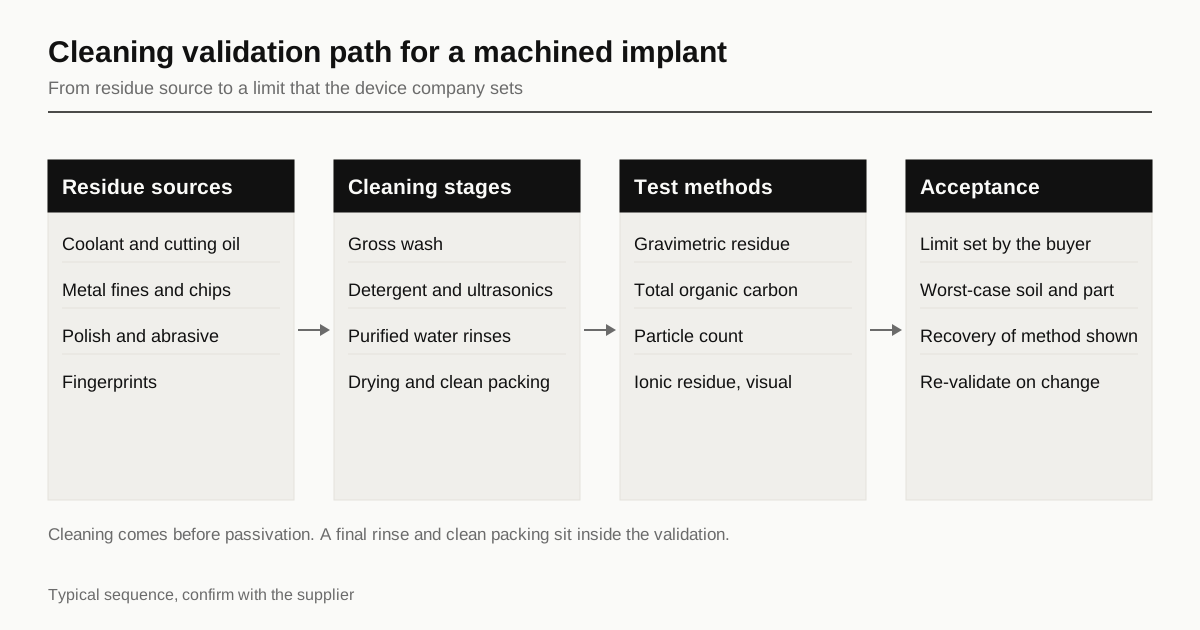
A machined implant leaves the cutting stage covered in things that must not reach the patient. Coolant, oil, fine metal particles, polishing compound and handling marks all stay on the part until a cleaning process takes them off. This guide covers what those residues are, how a cleaning process is validated and what to ask a supplier to show you.
What is on the part after machining
Cutting fluid is the largest source. Water-miscible coolants leave a film that dries to a residue, and straight oils used on Swiss lathes leave a heavier one. Fine chips and fines from titanium and cobalt chrome lodge in threads, cannulations and cross holes. Polishing and deburring steps add compound and abrasive. People add fingerprints, which carry salts and oils.
Each class needs a different removal step and a different test. A single cleaning cycle rarely covers all of them, which is why cleaning lines are staged.
A typical cleaning sequence
Lines differ, and a supplier’s own sequence matters more than any template. A common shape runs through these stages:
- Gross removal. A first wash removes the heavy oil and chips.
- Detergent wash with ultrasonics. An aqueous detergent bath at a set concentration and temperature, often with ultrasonic energy to reach threads and blind features.
- Rinses. Several rinse stages, ending in purified water, to remove detergent.
- Drying. Hot air or vacuum drying, so the part leaves dry and does not stain.
- Packing. Clean handling and packaging in a controlled area, because a clean part can be re-soiled in minutes.
The process parameters are the things validation locks down: bath concentration, temperature, time, ultrasonic power, rinse water quality, drying time and load pattern.
How the validation is built
Validation follows the same installation, operational and performance logic described in our guide to IQ, OQ and PQ for machined medical parts. For cleaning, the specific questions are these.
What is the worst-case soil? The protocol deliberately loads parts with the heaviest soil the process will meet, such as the oil left by the slowest machine, then shows the cleaning removes it.
What is the worst-case part? The geometry that is hardest to clean sets the challenge. A cannulated screw with a long small bore is harder than a solid pin.
How is the residue measured? The test method has to be validated too. A method that cannot recover a known amount of residue from a test part tells you nothing.
What does the part have to pass? The acceptance limit comes from the device company, and the validation shows the process meets it with margin.
Test methods suppliers use
| Method | What it measures | Typical use |
|---|---|---|
| Gravimetric extraction | Total non-volatile residue by weight | Implants, often to ASTM F2459 |
| Total organic carbon | Organic residue in the extract | Detergent and oil traces |
| Particle count | Particles in the extract rinse | Fine metal and abrasive |
| Ionic or conductivity test | Ionic residue from detergent and salts | Rinse effectiveness |
| Visual inspection under magnification | Chips, stains and films | Screening after cleaning |
ASTM F2459 describes extracting residue from metallic medical components and quantifying it by gravimetric analysis. ISO 19227 sets general cleanliness requirements for orthopedic implants and is the document many buyers point to for implant cleanliness. ASTM F3127 is a guide for validating cleaning processes used during the manufacture of medical devices. Check the current edition of each before you cite it in a specification.
Who sets the limit
The limit is the buyer’s decision. It comes from the part’s contact with the body, its surface area, its material and the downstream steps, such as passivation, marking and sterilization. A machining shop can describe what its process achieves, but a limit chosen to match the shop’s result defeats the purpose.
If your drawing says only “clean per ISO 19227”, that is a start and not a complete requirement. Ask which test, which sampling and which limit. If you are not sure, the passivation and electropolish guide covers the surface step that often follows cleaning and affects how it is judged.
Problems that validation does not catch
- Re-soiling after cleaning. A clean part placed in a dirty bin is dirty again. Validation has to include handling and packing.
- Residue trapped in features. Blind holes, threads and cannulations hold liquid. Drain and dry steps matter as much as the wash.
- Cross-contamination. A bath that also cleans non-implant alloys can carry particles. Ask whether the line is dedicated.
- Drift in bath chemistry. Concentration falls with use. The validated range needs monitoring and a replacement schedule.
Cleaning, passivation and sterilization are three different jobs
Buyers sometimes treat these as one step called “finishing”, and the confusion costs money.
Cleaning removes residue left by machining and handling. It is about contamination.
Passivation removes free iron and builds a stable surface oxide on stainless steel, and a related treatment applies to titanium. It is about corrosion resistance, and it only works well on a clean surface. A part with oil on it passivates unevenly.
Sterilization kills microorganisms. It is a separate validated process, usually run by a contract sterilizer or by the device company, and it does not remove machining residue. A dirty part that goes through sterilization comes out sterile and dirty.
The order matters. Cleaning comes before passivation, and a final clean and rinse usually follows it. Each stage can add residue as well as remove it, which is why the last rinse and the packing step are inside the validation. Our article on choosing a sterilization partner covers the stage after this one.
A practical way to review a cleaning package
Treat the supplier’s validation report as a document to read, not a certificate to file. Five checks take less than an hour.
- Does the part on your drawing appear in the protocol, or a stated worst-case family member? If it is neither, the validation may not cover your part.
- Is the test method named and validated? A report that says “residue below limit” with no method is a claim and not evidence.
- Do the acceptance numbers match your specification? A limit set by the shop for a different customer may not match yours.
- Are the validated parameters the ones in the work instruction? A bath temperature in the report that differs from the floor setting is a finding.
- Is there a record of the last review? A protocol that has not been looked at since the line was installed is overdue.
None of this requires a quality engineer’s degree. It requires reading the report against the drawing, and that reading belongs to the device company. A report that survives these five checks is better evidence than any statement that the shop is “experienced with implants”.
What to ask a supplier
- Which cleaning stages do you run, and which parameters are validated?
- Which test methods did you validate and what is the recovery rate?
- Which worst-case part and soil did the protocol use?
- How is bath chemistry monitored and how often is it replaced?
- What changes trigger a re-validation?
- Where is the part packed and in what environment?
These questions also go into the quality agreement, where change triggers belong in writing.
Cost and where it shows up
Cleaning validation carries a one-off cost for protocol, parts consumed in testing and test lab fees, plus a running cost for monitoring bath chemistry and periodic checks. Many shops fold the running cost into the piece price and charge the one-off separately. If a quote shows neither, ask where it went. Read what drives the cost of a machined medical component for the wider picture.
We match buyers with machining suppliers and the buyer pays us nothing. We are not a machine shop, we do not validate cleaning processes and we do not qualify a supplier for you, because that stays in your own quality system. To send a drawing, request a quote and we reply within 24 business hours.
Sources
- ISO 19227, implants for surgery, cleanliness of orthopedic implants, general requirements
- ISO 13485:2016, medical devices, quality management systems (clause 7.5.2, cleanliness of product)
Standards and regulations change. Check the current text at the source before you rely on it in a submission.
Frequently asked questions
Who sets the acceptable residue limit on a machined implant?
The device company, from its risk assessment and the part's use. A machining shop can tell you what its process achieves, but the limit that counts is the one written into your specification. If the drawing gives no limit, ask for one before the first lot rather than accepting whatever the shop's process leaves.
Is a visual check enough to show a part is clean?
No. Visual inspection catches chips, stains and fingerprints. It does not measure oil films, detergent residue or fine particles. It is a useful screening step next to a quantitative test, never the validation itself.
Does cleaning validation have to be repeated if the coolant changes?
It should be assessed. A new coolant, detergent, bath temperature or part geometry can change what the cleaning process has to remove. The quality agreement should name which of those changes trigger a review or a re-validation.
Need a quote for this part?
Send the drawing. We match you with up to 3 medical machining suppliers and reply within 24 business hours.
Get matched with a medical machining supplier