Guides / Quality and Compliance
ISO 10993 and Cutting Fluids: How Machining Residue Enters the Biological Evaluation
October 31, 2026
ISO 10993 evaluates the finished device, so a machine shop has no ISO 10993 status to hold. It is a series of standards for the biological evaluation of a finished medical device, and the device company owns that evaluation. Machining still enters it, because the fluids, lubricants and cleaning agents used to make a part can leave residue on it. This guide explains how that residue connects to ISO 10993, what to ask the shop and what to put in your specification.
It sits next to our guide on cleaning validation for machined implants, which covers how a cleaning process is proven. This article covers the question before it: why the chemistry on the part matters to a biological evaluation, and what the shop has to disclose for you to answer it.
What the regulators say about processing residue
Neither FDA nor the EU names machine shops. Both name the thing a machine shop adds.
FDA’s guidance on ISO 10993-1, issued on 8 September 2023, tells the sponsor to assess the final finished device. It says the risk assessment should evaluate not only the materials in the device but also “the processing of the materials, the manufacturing methods (including the sterilization process), and any residuals from manufacturing aids used during the process”. The guidance refers to the 2018 edition of ISO 10993-1. Check which edition applies on the day you file.
The EU wording is parallel. Annex I section 10.2 of Regulation (EU) 2017/745 requires devices to be designed, manufactured and packaged to minimise the risk posed by contaminants and residues to patients, with attention to the tissues exposed and to the duration and frequency of exposure. Section 10.4.1 asks that risks from substances or particles, including wear debris, degradation products and processing residues, be reduced as far as possible. Annex II section 3 asks the technical documentation to cover the manufacturing processes, their validation and their adjuvants.
A cutting fluid is a manufacturing aid. The rule is therefore plain: the fluid that touched your implant during machining is part of what you assess, even though you never bought it.
Where residue comes from
| Source | What it can leave | How it is usually controlled |
|---|---|---|
| Cutting fluid | Oil film or dried concentrate, plus any additives | Choice of fluid, filtration, cleaning after machining |
| Lubricant leaking into the coolant | Slideway or hydraulic oil carried onto parts | Machine maintenance and skimming, cleaning after machining |
| Cleaning agents | Detergent or solvent film | Rinse stages and a drying step |
| Deburring and polishing media | Abrasive and compound | Cleaning after the media step |
| Handling and packing | Skin oils, salts, particles | Gloves, clean packing area |
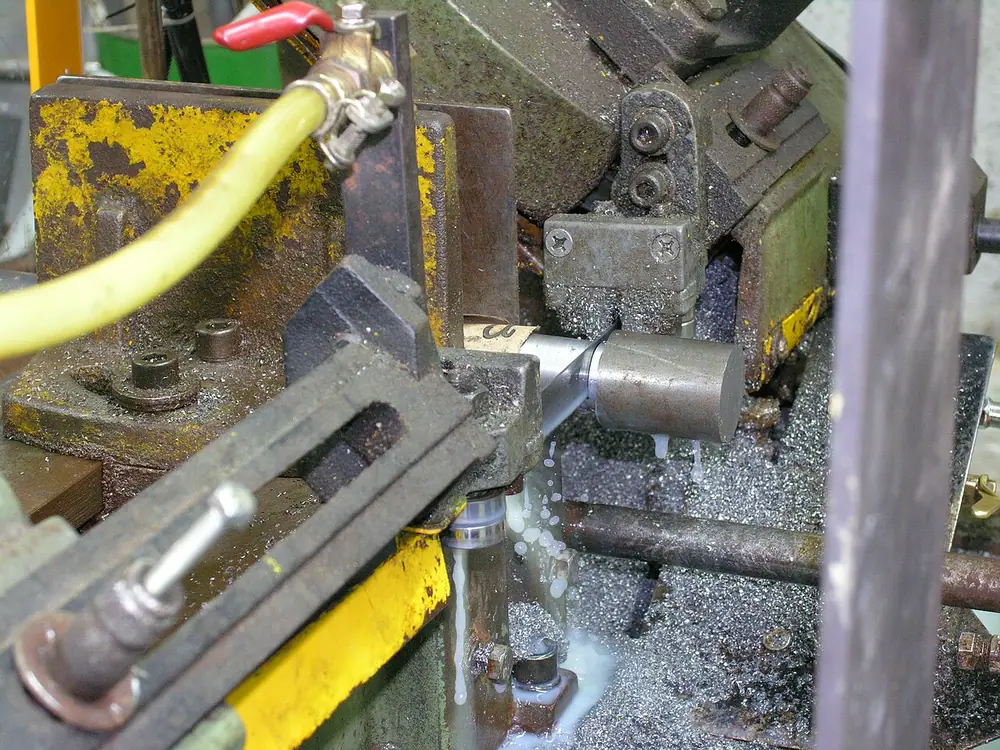
OSHA’s description of metalworking fluids helps with the first row. It groups them as straight oils, soluble oils, semi-synthetic fluids and synthetic fluids, the last three mixed with water before use. It lists additives found across the classes, including stabilizers, biocides, dispersants, dyes and odorants, and notes that synthetic fluids can contain detergent-like components. The page is written for worker health, not patient safety, but it shows why a cutting fluid is a mixture and not a single substance. Each additive is a chemical that may stay on the part.
How ISO 10993 picks up the residue
ISO 10993-1 works from the device’s body contact and its contact duration. FDA’s Table A.1 sorts devices by contact category and by duration: limited (under 24 hours), prolonged (24 hours to 30 days) and long term (over 30 days). Against each combination it lists the endpoints to consider, from cytotoxicity, sensitization and irritation to acute systemic toxicity, material-mediated pyrogenicity, subacute and subchronic toxicity, genotoxicity, implantation, hemocompatibility, chronic toxicity and carcinogenicity. The long-term implant rows carry the longest lists.
FDA adds that every marked endpoint “should be addressed” in the biological safety evaluation, through existing data, endpoint-specific testing or a rationale for why the endpoint does not warrant further assessment. The rationale route is where machining information earns its keep.
Chemical characterisation is the second route. FDA says that if the identity and quantity of component chemicals cannot be obtained, for example from a material supplier, chemical characterisation of device extracts in polar, semi-polar and non-polar solvents may be sufficient to support the evaluation. It points to ISO 10993-18 for that work and says saline is the right polar solvent for devices with metal components. It also describes the toxicological threshold of concern approach as a way to judge whether quantification without identification is enough.
Put in plain terms, the less you know about what was on the part, the more you have to measure. A shop that gives you the fluid name, its safety data sheet and a stable change record turns an open question into a documented one. That is the whole commercial case for asking.
One more line from the FDA guidance matters for suppliers. When it suggests how to claim that a material matches a previously evaluated one, the wording requires the component to be identical in formulation, processing, sterilization and geometry, with “no other chemicals” added, and it lists cleaning agents among the examples. A coolant change after your testing is exactly such an addition.
What you should ask the shop
- Which cutting fluids touch my part number, by product name and supplier, and can you send the safety data sheets?
- Is the fluid fixed for my part number, and how do you tell me before it changes?
- Do other alloys or non-medical work share the same coolant sump or the same wash line?
- Which cleaning agents and rinse waters do you use after machining, and which stage removes cutting fluid?
- What residue tests do you run on medical lots, to which method, and what are the results for my last lot?
- Which deburring and polishing media touch the part, and do they stay with medical work only?
Shops that already run implant work often answer these quickly. A shop that cannot name its coolant for your part number has told you where its process control stops.
What to write on the drawing and in the agreement
Specify a cleanliness requirement and its method. Gravimetric extraction under ASTM F2459, which extracts residue from metallic medical components and quantifies it by weight, is one common method for metallic parts. Other methods suit other residues, and the cleaning validation guide compares them. Whatever you choose, state the test, the sampling and the limit. No public limit applies to every machined part, and the limit comes from your risk assessment and the device’s contact.
Then add the disclosure terms:
- An approved list of cutting fluids and cleaning agents per part number, with data sheets on file.
- Named change triggers for fluids, cleaning chemistry, tool coatings and deburring media, with notice before the change. The guide to supplier change notification lists the other triggers and the notice contents.
- A dedicated line or a cleaning step validated for mixed use, if the shop machines other work on the same equipment.
Cost and where it appears
There is no public price list for biological evaluation. Laboratories quote per endpoint, and the work that residue adds depends on the contact category and on what you already know. Two costs are easy to name. One is the shop’s cost of holding a fixed coolant and a dedicated wash line, which may appear in the piece price. The other is your cost when a change slips in unannounced and the earlier test data no longer cover the product. Read what drives the cost of a machined medical component for the wider picture.
Where this leaves you
The shop contributes facts. You carry the evaluation. Before the next order, list every processing aid that touches your part, write the fluid and cleaning agent into the agreement and ask for the change trigger. Then request a quote with those terms attached.
We match buyers with machining suppliers and the buyer pays us nothing. We are not a machine shop, we do not test or certify anything and we do not qualify a supplier for you, because that stays in your own quality system. We reply within 24 business hours.
See also: PFAS restrictions and fluoropolymer parts, for the material inventory a device maker starts with.
Sources
- FDA, Use of International Standard ISO 10993-1, Biological evaluation of medical devices, Part 1 (guidance issued 8 September 2023)
- Regulation (EU) 2017/745, Annex I sections 10.2 and 10.4.1, Annex II section 3 (EUR-Lex)
- OSHA, Metalworking fluids, health effects (fluid types and additives)
- ASTM F2459, Standard Test Method for Extracting Residue from Metallic Medical Components and Quantifying via Gravimetric Analysis
Standards and regulations change. Check the current text at the source before you rely on it in a submission.
Frequently asked questions
Is there an ISO 10993 certificate a machine shop can hold?
Not for the shop itself. ISO 10993 is a series of standards for the biological evaluation of a finished device, and the device company owns that evaluation. A machine shop can supply facts that feed it, such as which cutting fluid it uses and how its parts are cleaned. A claim of ISO 10993 compliant machining is a marketing phrase, not a status.
Does passing a cleaning validation mean the part is biologically safe?
No. A cleaning validation shows that residue falls below a limit you set. The biological evaluation asks whether the remaining chemistry is acceptable for the contact and duration of the device. The two documents connect, and neither replaces the other.
Do I have to repeat biological testing when the shop changes its coolant?
Not automatically. A change of coolant, cleaning agent or process is an input to your risk assessment, and the assessment decides whether existing data still represent the product. That is why the change should be named as a trigger in the quality agreement, so you hear about it first.
Who sets the acceptable residue limit?
The device company, from its risk assessment and the part's use. No public limit applies to every machined part. The shop reports what its process achieves, and your specification states what you accept.
Need a quote for this part?
Send the drawing. We match you with up to 3 medical machining suppliers and reply within 24 business hours.
Get matched with a medical machining supplier