Home / Device families
Machined medical part families
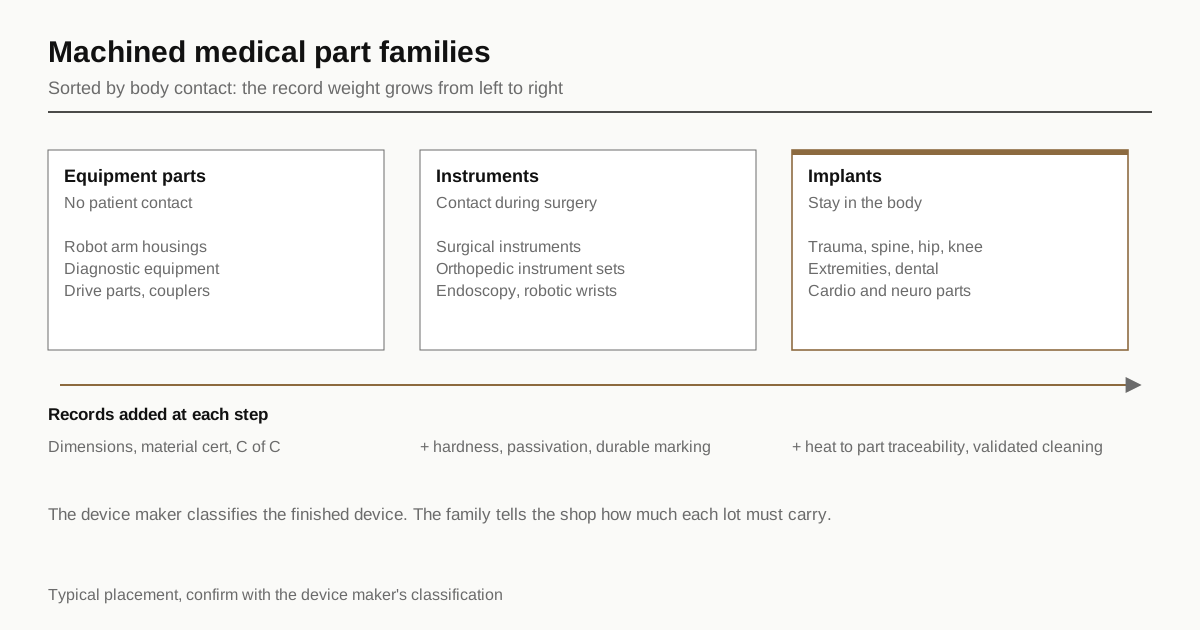
A machined medical part belongs to a device family, and the family decides the material specification, the risk class of the finished device and the records each lot has to carry. This page maps the families and links to one detail page per family.
| Families on this page | 11, from hip implants to cardiovascular small parts |
|---|---|
| Four sorting questions | Implant, instrument or equipment; body contact; device risk class; reusable or single use |
| US classification | 21 CFR parts 872 (dental), 876 (gastroenterology and urology), 878 (general surgery), 888 (orthopedic) and others |
| EU classification | EU MDR 2017/745, Annex VIII rules 1 to 22 |
| Who classifies the device | The device maker, under FDA or notified body review. A shop works to the consequences. |
The family map
The table lists the part families that reach machine shops most often. The material column names the specifications that appear on drawings in each family. The records column names what weighs most in a lot file, on top of the dimensional report every lot needs.
| Family | Typical machined parts | Typical material specifications | Records that weigh most |
|---|---|---|---|
| Hip | Femoral stems, acetabular shells, modular necks, femoral heads, liners | ASTM F136, F1537, F75 (cast), F648 (UHMWPE) | Heat to part traceability, taper and bearing surface inspection, cleaning |
| Knee | Tibial trays, femoral components (often cast then machined), inserts | ASTM F136, F75, F1537, F648 | Traceability, finish on articulating surfaces, cleaning |
| Spine | Pedicle screws, tulip heads, set screws, rods, cross connectors, cages, cervical plates | ASTM F136, F67, F1537, F2026 (PEEK) | Traceability per implant, thread and assembly checks, cleaning, set content |
| Trauma | Bone plates, bone screws, intramedullary nails, pins and wires | ASTM F138, F136, F67 | Traceability, colour coding records, edge and hole finish |
| Extremities | Small joint stems, small screws, staples, plates for hand and foot | ASTM F136, F67, F2063 (nitinol staples) | Micro feature inspection, traceability, cleaning |
| Dental | Implant fixtures, abutments, abutment screws, healing caps, analogs | ASTM F67 Grade 4, F136 | Connection geometry, surface treatment records, cleaning, sterile packaging inputs |
| Surgical instruments | Jaws, shafts, handles, ratchets, retractor blades | ASTM F899 stainless grades, ISO 7153-1 | Hardness after heat treatment, passivation, durable marking |
| Orthopedic instrument sets | Reamers, drills, broaches, guides, trials, impactors | ASTM F899 (17-4 PH, 420, 440 grades), F136 for some trials | Cutting edge geometry, hardness, marking, set completeness |
| Endoscopy and minimally invasive | Tubes, tips, articulation links, jaw inserts, housings | ASTM F899 grades, F138, medical polymers | Micro dimensions, burr free bores, cleaning validation inputs |
| Surgical robotics | Instrument wrists, drive parts, arm housings, couplers | Stainless and titanium grades, aluminium for housings | Precision inspection, assembly fit, change control |
| Cardiovascular and neuro | Lead connectors, marker bands, micro housings, stent tooling | ASTM F562 (MP35N), F2063 (nitinol), F560 (tantalum), platinum iridium | Micro tolerance, material traceability on small lots, cleanliness |
Typical pairings only. The drawing and the device maker's file decide the actual specification for each part.
Four questions that sort any part
Before a family, every machined part answers four questions. The answers explain why two parts that look alike on the machine can carry very different paperwork.
| Question | Possible answers | What changes for the shop |
|---|---|---|
| Implant, instrument or equipment? | Stays in the body; touches the patient during surgery; never touches the patient | Material specification, cleanliness and traceability depth |
| What body contact? | Nature and duration of body contact, as the device maker categorises it under ISO 10993-1 (2025 edition current) | Residue limits, cleaning validation, allowed process fluids |
| What risk class is the finished device? | US class I, II or III; EU class I, IIa, IIb or III | How much the device maker audits the shop and how strict change control is |
| Reusable or single use? | Reprocessed many times; used once and discarded | Corrosion resistance, marking durability, finish that cleans well |
The answers belong to the device maker. A shop that asks for them is not being difficult: it is pricing the right amount of cleaning, inspection and record keeping. The applications overview shows the same split by clinical area.
How the US and the EU class these families
Risk class belongs to the finished device. The examples below show where common families tend to land, with the regulation that sets it. Product codes and rules have exceptions, so the device maker's regulatory team has the final word.
| Family | US example (21 CFR) | EU tendency (MDR Annex VIII) |
|---|---|---|
| Trauma plates, screws, nails | 888.3030, 888.3040, 888.3020: class II | Implantable, rule 8: class IIb |
| Pedicle screw systems, fusion cages | 888.3070 and 888.3080: class II (cages with a biologic are class III) | Implants in contact with the spinal column: class III, components such as screws, wedges and plates excepted |
| Hip and knee replacement | Mostly class II, some designs class III (check the product code) | Joint replacements: class III |
| Dental implants and abutments | 872.3640 and 872.3630: class II with special controls | Implantable: class IIb in most cases |
| Manual surgical instruments | Often class I, many exempt from premarket notification | Reusable surgical instruments: class I with notified body review of reuse aspects |
Information, not regulatory advice. Confirm the class of your device with your regulatory team and, in the EU, your notified body.
How the detail pages relate
Each family gets its own page with the part list, the material specifications, the test standards the device maker relies on and the records a lot should carry. The family pages link down to the material specification pages, such as the implant callout for Ti-6Al-4V ELI and the wrought cobalt chrome specification, and across to the standards pages on purchasing controls. Blog guides keep the narrower questions: cost, a single process, a single comparison. For example, the guides on hip implant machining, bone plate cost and finish, endoscope components and surgical robot parts sit under their family pages.
What stays the same across every family
Some records appear on every lot, whatever the family:
- A drawing revision and a purchase order revision that match.
- A material certificate tied to the lot by heat or batch number.
- A traveler that shows each operation, including outside processes such as passivation, heat treatment or marking.
- A dimensional report against the characteristics the drawing marks as critical.
- A certificate of conformance that names the drawing, the revision, the quantity and the lot.
- A written promise to tell the device maker before the shop changes the material source, the process or a sub-tier.
What changes by family is depth: how many characteristics are critical, how tightly cleaning is controlled and how far traceability reaches. A family page tells you where on that scale your part sits. When you know, send the drawing and say which family the part belongs to. Qualification of the shop stays with your quality system, as how we check a supplier explains.
Frequently asked questions
Why group machined medical parts by device family instead of by material?
Because the family decides most of what the part must leave behind: the material specification, the cleanliness level, the traceability depth, the test standards the device maker relies on and the risk class of the finished device. Two parts in the same alloy can need very different records if one is a trauma screw and the other is an instrument handle.
Does a component supplier need to know the device class?
It helps, but the class belongs to the finished device and the device maker. What the shop needs is the consequence: which records, which cleaning, which marking and how much change control the purchase order asks for. A good RFQ states those directly.
Are instruments easier to source than implants?
Usually, yes. Most manual surgical instruments sit in the lowest risk class in the US and the EU, and they do not stay in the body. Reusable instruments still need materials that survive repeated cleaning and sterilization, and marking that stays legible, which is where many first lots fail.
Which family carries the heaviest documentation per part?
Implants that stay in the body permanently, in particular joint replacement and spinal implants in contact with the spinal column, which the EU MDR places in class III. Expect full heat to part traceability, validated cleaning and a written agreement on changes.
Sources
- 21 CFR 888.3030, metallic bone fixation appliances (eCFR)
- 21 CFR 888.3070, pedicle screw spinal systems (eCFR)
- 21 CFR 888.3080, intervertebral body fusion device (eCFR)
- 21 CFR 872.3640, endosseous dental implant (eCFR)
- Regulation (EU) 2017/745 on medical devices, Annex VIII (EUR-Lex)
- ISO 10993-1:2025, biological evaluation of medical devices, part 1
Standards and regulations change. Check the current text at the source before you rely on it in a submission.
Last reviewed 18 October 2026
Need a quote for this part?
Send the drawing. We match you with up to 3 medical machining suppliers and reply within 24 business hours.
Get matched with a medical machining supplier