Guides / Cost
Bone Plate and Trauma Plate Machining: Cost and Finish
October 7, 2026
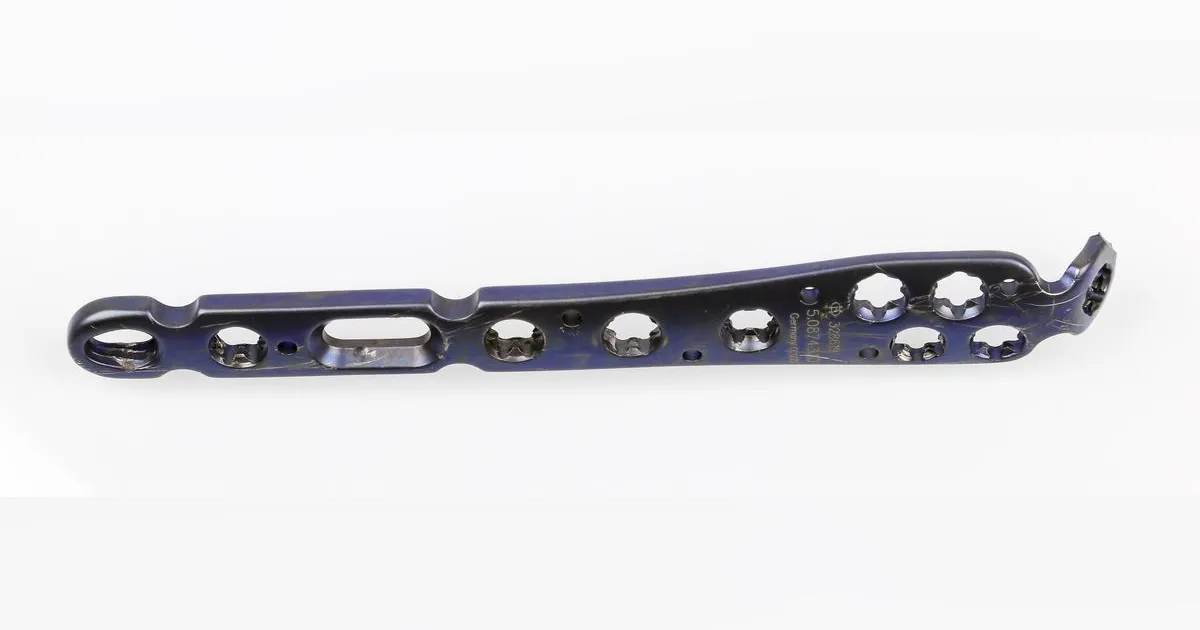
A bone plate looks simple: a flat strip of metal with holes. A plate with eight hole forms, a bend along its length and a polished finish can take longer to make than a screw ten times its weight in metal. This guide explains how plates are made, what drives the price and how to specify them so that quotes compare.
What a plate does
A bone plate holds the ends of a broken bone in position while it heals. Screws pass through holes in the plate into the bone. Some plates compress the fracture, others bridge it and lock the screws to the plate so that the plate carries load. ASTM F382 is the specification and test method for metallic bone plates, including bending tests. Design and testing belong to the device company.
Plates come in many families: straight plates for long bones, contoured plates for the end of a bone, mini plates for the hand and face and large plates for the femur and tibia. Thickness varies from a fraction of a millimetre for facial plates to several millimetres for large ones.
Hole types and why they matter
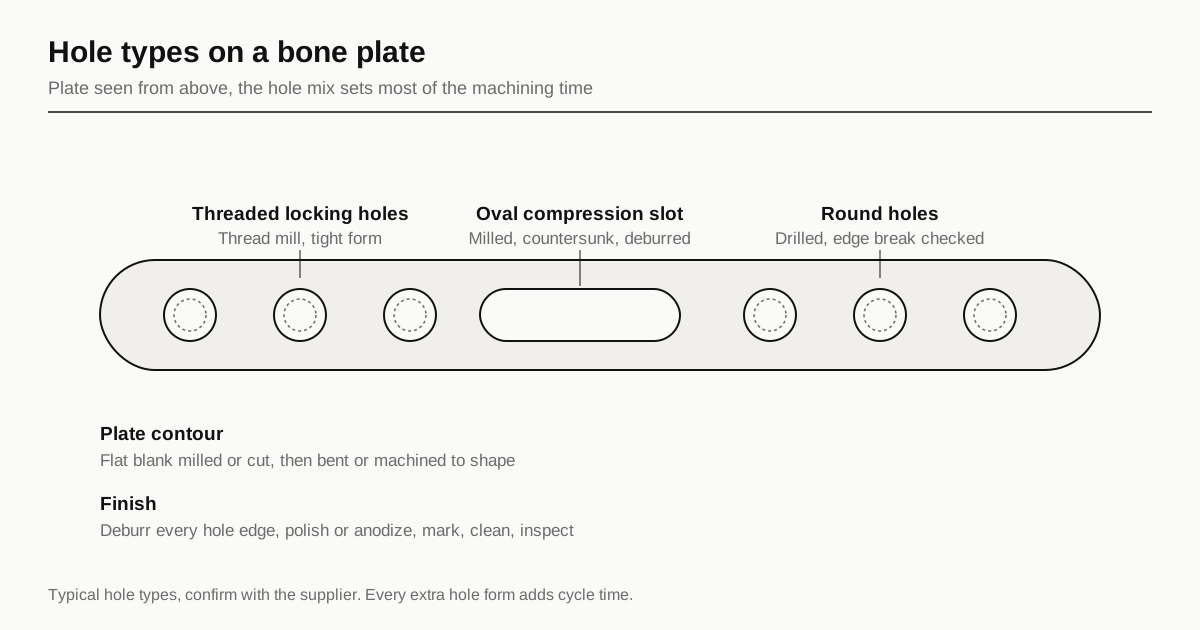
The hole mix sets the cost. The diagram at the top of this guide shows the common forms.
| Hole type | What it does | Machining note |
|---|---|---|
| Round compression hole | Accepts a standard screw | Drill, countersink and edge break |
| Oval compression slot | Lets the surgeon compress the fracture | Milled slot with a sloped seat |
| Threaded locking hole | Locks the screw head into the plate | Thread mill or tap, gauge each hole |
| Combination hole | Takes either screw type | Combined form, the hardest to cut and check |
| Suture or wire hole | Small holes for fixation or wires | Small drills, burr control |
Typical forms, confirm with the supplier. A plate with fifteen locking holes costs more than one with fifteen plain holes by a wide margin. Each hole has several cutting steps, and each locking thread has a gauge check.
How plates are cut
Plates start as flat stock, which is rolled plate or strip, or as bar that is milled flat.
- Blank cutting. The outline is cut by laser, waterjet, wire EDM or milled from the plate. Laser and wire cuts leave a heat affected edge that later steps have to clean.
- Hole making. Holes are drilled, countersunk and thread milled on a vertical machining centre. High-volume work may use a dedicated fixture with many plates at once.
- Profile and thickness changes. Some plates are thinner at the ends or have scalloped edges between screw holes to reduce stiffness. These are milled in the same setup or a second one.
- Contouring. Plates may be pre-bent to match the bone. Some shops bend them in a press with a fixture, and others mill the contour directly from thick stock.
- Deburring and finishing. Every hole edge, outline edge and undercut is broken and smoothed.
The five-axis route suits sculpted anatomical plates. The three-axis route with a flip fixture suits flat plates. Our guide to medical component machining cost explains how setup count shapes the quote.
Material and bar certificates
Titanium plates are made from unalloyed grades or from Ti-6Al-4V ELI. Stainless steel plates use implant stainless to the relevant standard. Plate and strip come with their own certificates, and thin material has a condition that affects bending. Our guide to medical bar stock certificates shows how to read the paper, and the reading order applies to plate too. The difference between alloys is covered in Ti-6Al-4V ELI against Grade 4 titanium.
Finish: where the time goes
A plate sits against bone and tissue, so finish matters. Common steps:
- Hole edge breaks. Every hole edge needs a radius or chamfer, and the edge between the hole and the underside has to be free of burrs that could damage tissue or the screw head. Our guide to deburring medical parts covers acceptance.
- Polishing. Plates are often tumbled, blasted or hand polished to a drawn finish. Some designs call for a polished face and a matte underside.
- Anodizing. Titanium plates are often anodized, and the colour identifies the plate or screw size family.
- Passivation. Stainless steel plates are passivated, and our guide to passivation and electropolish covers that.
- Marking. Laser marking carries the lot and the part number. See our guide to UDI laser marking.
- Cleaning. A final clean and packaging in a controlled step.
On many plates the finishing cost matches or exceeds the cutting cost, because much of it is manual or batch work with its own inspection.
Contour and form tolerance
A plate shaped to fit a bone has a contour tolerance that the drawing states. Checking a three-dimensional contour needs a CMM, a scan or a template. A plate that springs back after bending is a known issue. If a contour matters, the drawing should state how it is measured and at what stage.
Cost drivers
| Driver | Why it matters |
|---|---|
| Hole count and hole mix | Each hole is cut, finished and gauged |
| Locking thread form | Thread milling time and tool wear |
| Thickness and stock | Titanium plate is costly and scrap rises with nested shapes |
| Contour | Fixtures, five-axis time or a bending step |
| Finish | Hand work, anodize lots and cleaning |
| Inspection | Hole position by CMM, thread gauges, contour check |
| Size range | Many lengths multiply setups and records |
Typical drivers, confirm with the supplier. A family of plates in several lengths shares a lot of setup if the hole pitch is the same. A drawing set that holds pitch and hole form constant lets a shop use one fixture across lengths.
Quote comparison traps
Three things make plate quotes hard to compare.
- Different finish assumptions. One quote includes hand polishing, another bead blast only.
- Different inspection plans. One shop gauges every thread, another samples.
- Different stock. One quote prices cut-to-size plate, another nested sheet.
The fix is a drawing or an attached specification that states finish, inspection and stock form.
Edges, undersides and tissue contact
A plate lies against bone on one side and against soft tissue on the other. The side against tissue is often rounded and smooth, because sharp edges can irritate muscle and tendon. The underside, or bone side, may have small grooves or a texture that reduces contact. Edge radii between holes are drawn as a callout, and a shop checks them with an optical comparator or by eye against a sample.
Handling and packaging
Plates are thin and soft compared with tools. A scratch on a polished face is a cosmetic reject and sometimes a functional one. Parts move between operations in trays with separators, never loose in a bin. Titanium plates also take up marks from steel tools and fixtures, so shops use soft jaws and clean trays. Ask how plates are carried between machining, finishing and packing, and whether packaging is done in a controlled area.
Next step
Before you request quotes, count the hole forms on each plate, state the finish on each face and say how the contour is measured. Ask each shop to list its finishing steps and how many are done in house.
For how to read and compare the quotes a plate drawing brings back, see the medical machining quote guide.
We match buyers with machining suppliers and the buyer pays us nothing. We do not machine plates and we do not qualify a supplier for you, because that stays in your own quality system. To send a drawing, request a quote and we reply within 24 business hours.
See also: surface finish requirements on implants, for who sets the roughness number on a plate.
Sources
- ASTM F382, metallic bone plates
- ASTM F136, wrought titanium-6aluminum-4vanadium ELI alloy for surgical implant applications
Standards and regulations change. Check the current text at the source before you rely on it in a submission.
Frequently asked questions
What are bone plates made from?
Most are titanium, either unalloyed grades or Ti-6Al-4V ELI to ASTM F136, or implant-grade stainless steel. Titanium is lighter and shows less on imaging. Stainless steel is stiffer and cheaper. The design file names the material and the choice is a clinical and regulatory one, not a machining one.
Why do locking holes cost more than plain holes?
A locking hole has a thread or a conical form that the screw head locks into. It is cut with a thread mill or a tap and checked with a gauge. A plain hole is drilled and countersunk. The locking form takes more cycle time, more tool wear and a tighter inspection.
Is a plate cut from sheet or machined from a block?
Both are used. Thin plates are often cut from flat stock by laser, waterjet or wire EDM, then drilled and machined. Thicker or more sculpted plates are milled from plate or bar. The route depends on thickness, shape and volume.
Need a quote for this part?
Send the drawing. We match you with up to 3 medical machining suppliers and reply within 24 business hours.
Get matched with a medical machining supplier