Guides / Technical
Surgical Robot Components: Precision Parts Outside the Body
October 23, 2026
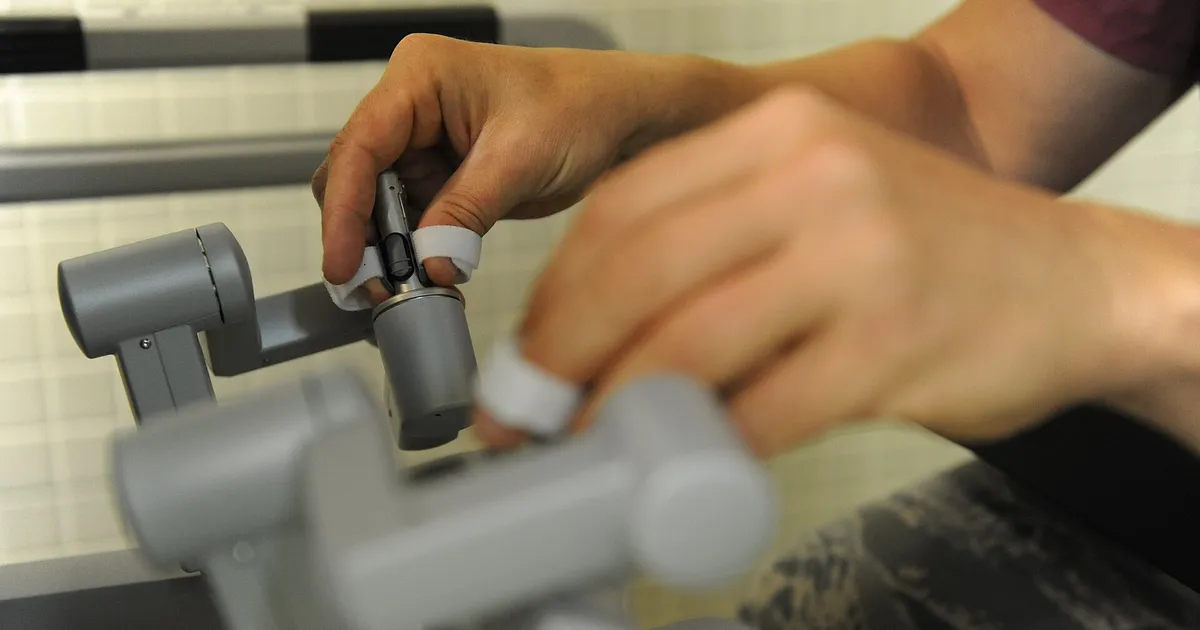
Surgical robots look like a different world from bone screws, and for the machine shop they are. A robot arm is a long chain of structural parts, gear housings, shafts and covers. Most of them never touch a patient. A few do. Each group needs a different level of control, and a buyer who treats them all alike overpays or under-controls. This guide walks through the groups, the machining notes for each and what to ask a supplier.
What a robotic surgery system is made of
A typical system has three kinds of hardware.
- A surgeon console. Controllers, a viewer, foot controls and a frame. The surgeon sits here, away from the patient.
- A patient-side cart. A base carrying several arms that hold instruments and a camera.
- Instruments and accessories. Wristed instruments with shafts and jaws, sterile drapes and adapters that connect each instrument to its arm.
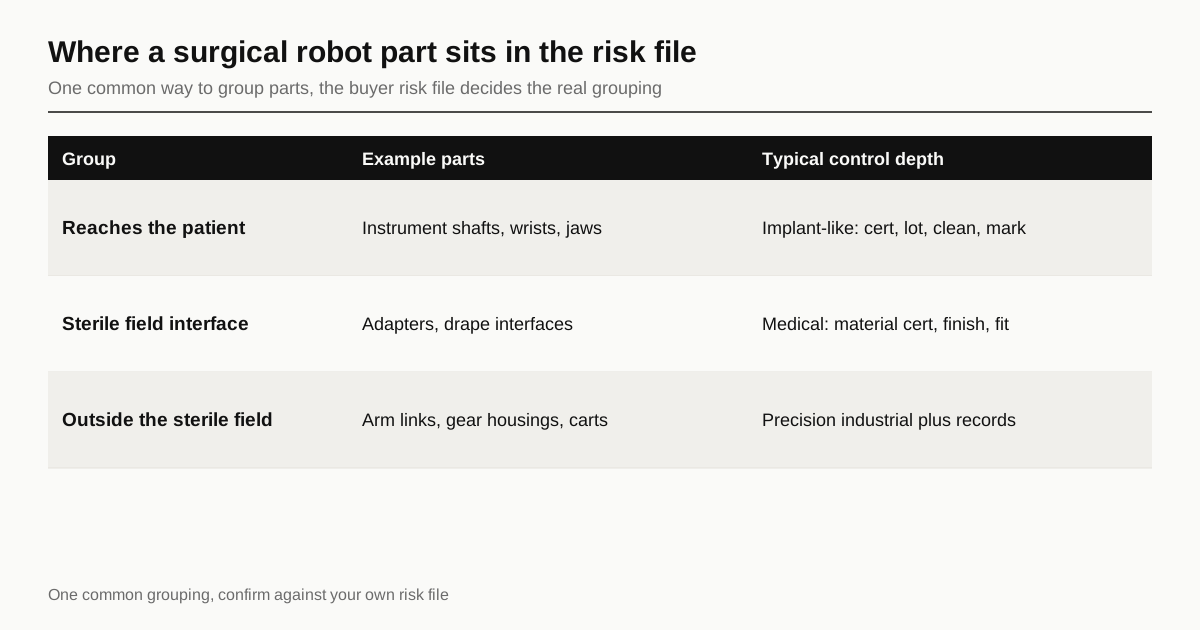
The diagram at the top of this guide shows one way to group the parts by their closeness to the patient. The grouping is common in practice, though the device company’s risk file sets the real one. Our guide to medical component machining cost explains how that risk level carries into price.
Group one: parts that reach the patient
Instrument shafts, wrists, jaws and tips enter the body. They are small, slender and made of stainless steel or titanium. They resemble the parts in laparoscopic instruments and follow similar rules. Typical features:
- Long, thin tubes and rods that need straightness
- Pivot pins and clevis joints with tight clearances
- Jaws that may be wire cut or made by metal injection moulding
- Cable guides and pulleys in the wrist
- Surfaces that have to be cleaned and often reprocessed
Controls are close to those for surgical instruments: material certificate, passivation, cleanliness and lot traceability. Our guide to laparoscopic instrument machining covers those parts.
Group two: the sterile interface
Between each instrument and its arm sits an adapter or interface, often with a sterile drape between them. Interface parts carry torque and motion from the arm into the instrument. They are made from stainless steel, aluminium or engineering plastic. Key features are accurate coupling forms, wear surfaces and a finish that cleans well. Some are single use and some are reprocessed. Which group applies is a device company decision.
Group three: structure outside the sterile field
Most of the mass of a robot sits here. Arm links, joint housings, gearbox cases, motor mounts, bases, columns, console frames and covers.
| Part | Typical material | Machining notes |
|---|---|---|
| Arm link | Aluminium alloy, sometimes magnesium or titanium | Long pockets, thin walls, bores for bearings |
| Gearbox or joint housing | Aluminium or steel | Bore size, position and squareness matter most |
| Shaft | Alloy or stainless steel | Concentricity, ground journals, keyways |
| Motor mount and bracket | Aluminium | Flatness and hole position |
| Cart base and column | Steel or aluminium, welded or cast | Machined interfaces on large parts |
| Cover and trim | Aluminium or plastic | Cosmetic finish, fit to adjacent covers |
Typical choices, confirm with the supplier. Many of these parts are not unlike those in other precision machines such as semiconductor tools or lab automation.
Tolerance, stiffness and weight
A surgical robot has to move precisely and stay stiff. Arm links are designed to be light and stiff, which means thin walls, ribs and deep pockets. Cutting these in aluminium risks distortion when the part is released from the vise. Experienced shops rough, release stress and finish, and they may stress relieve a part between operations. Bore positions on a joint housing set how bearings and gears align, so those features carry the tight tolerances. Our guide to tolerances on machined medical parts covers how to pick tolerances without paying for ones the part does not need.
Surface and cleanability
Robot surfaces are wiped with hospital disinfectants, often many times a day. The finish has to survive that. Common finishes are anodize on aluminium and powder coat or paint on larger frames. Passivation suits stainless steel. A good drawing also avoids crevices, sharp inside corners and exposed threads where fluid can sit. Some coatings craze under certain disinfectants, so the buyer’s cleaning agents belong in the request.
Cosmetic and visible parts
Covers and trim are seen by the surgical team and the hospital’s buyers. Cosmetic requirements are often written as a visual standard with sample parts: no tool marks, no mismatched anodize colour, a stated gap to the next cover. Cosmetic rejects are a real cost on these parts, and the sample or visual standard should be agreed before the first lot.
Volume and the quote
Robot parts are made in low to medium volume. A system has dozens or hundreds of distinct parts and a small number of systems per year, compared with a screw produced in thousands. A buyer can often cut cost by:
- Standardizing materials and thicknesses across parts
- Giving a tolerance only where a function needs it
- Asking for quotes at several quantities
- Releasing parts in families so that setup spreads
Documentation
A part in the robot is still a medical device component. A device company will want a material certificate, a first article inspection, a lot record and a drawing revision on each shipment. The depth depends on risk. A cart base needs less than an instrument jaw. ISO 14971 describes the risk management process that decides it, and the decision belongs to the device company.
We will say the thing that costs us a lead. For arm links, covers and frames, a buyer may not need a supplier with a full implant-style quality system. A good precision shop with a clear quality agreement and a first article may do the job. For parts that reach the patient, the bar is higher, and the quality agreement should say so. Our guide to qualifying an ISO 13485 machining supplier explains what a buyer can check.
Bearing bores and gear interfaces
Joint housings carry bearings, and the bearings carry the arm. The bore size, roundness, squareness to the mounting face and position relative to other bores all affect how smoothly a joint turns. Most shops bore these features in one setup, so the relationship between them comes from the machine and not from moving the part. Where a joint has bores on two sides of a housing, a flip setup or a five-axis machine keeps the relationship tight. Gear and coupling interfaces add form tolerances that need a CMM or a dedicated gauge.
A buyer should state which datum scheme the bores follow. If the drawing leaves it open, two shops will choose different datums, cut different parts and both pass their own inspection.
Measuring large parts
Arm links and bases are large compared with most medical parts. Measuring them needs a bridge CMM with enough travel or a portable arm, and the shop’s inspection room has to hold temperature steady, because aluminium grows with heat. Ask each shop about the largest part its CMM can hold and about the room temperature at inspection. A shop that cannot measure the part it cuts is not a fit, however good its machines are.
From prototype to production
Robot programs begin with a few prototype systems and then grow to a production line. Prototype parts are often cut from billet with long cycle times. Production parts may move to castings, extrusions or forgings with machined interfaces. A change of blank changes grain, stress and distortion, so a part that passed as a billet part needs a new first article as a casting. Plan the transition early and tell the shop which parts may move to a different blank.
Next step
Before you request quotes, sort your parts into the three groups and state the control depth for each. Send the groups as separate requests so shops can quote the right level of documentation for each.
We match buyers with machining suppliers and the buyer pays us nothing. We do not machine robot parts and we do not qualify a supplier for you, because that stays in your own quality system. To send a drawing, request a quote and we reply within 24 business hours.
See also: RoHS and machined medical device parts, on lead in alloys and the declaration a supplier gives.
Sources
- ISO 13485:2016, medical devices, quality management systems
- ISO 14971:2019, medical devices, application of risk management to medical devices
Standards and regulations change. Check the current text at the source before you rely on it in a submission.
Frequently asked questions
Do surgical robot parts need implant-grade material?
Mostly not. Arm links, housings and carts are non-implant parts and use ordinary engineering alloys such as aluminium and stainless steel. Parts that reach the patient, such as instrument shafts and jaws, follow instrument rules and use instrument-grade stainless steel or titanium. The device company's risk file sets which applies.
Does a robot part supplier have to be ISO 13485 certified?
That is a device company decision. Some buyers require it for every supplier of a medical system, others set controls by risk and accept a good industrial shop for structural parts. We do not decide this for a buyer. The quality agreement should state it, whichever way it goes.
Why are robot arm parts expensive if they are just aluminium?
The cost is in tolerance, flatness, bore fit, cosmetic finish and documentation. Arm links and gearbox housings carry bearings and precision gears, so bore size, position and squareness are tight. A first article and a lot record also add time that a plain industrial part would not carry.
Need a quote for this part?
Send the drawing. We match you with up to 3 medical machining suppliers and reply within 24 business hours.
Get matched with a medical machining supplier