Guides / Quality and Compliance
Medical Bar Stock Certs: What to Ask Before the First Lot
October 18, 2026
A drawing says Ti-6Al-4V ELI to ASTM F136, a shop buys bar, and the first lot ships. Months later an auditor asks for the certificate and finds that the edition is old, the heat number does not match the bar tag or the document is a certificate of conformance with no test data. The fix at that point is slow and costly. This guide lists what to ask for before the first lot, how to read the certificate and where buyers and shops usually slip.
Medical grade is not a standard
Metal suppliers use the phrase “medical grade” freely. No standard defines it. What counts is the specification on your drawing: ASTM F136 for Ti-6Al-4V ELI, ASTM F138 for 316LVM stainless steel, ASTM F67 for unalloyed titanium, ASTM F1537 for cobalt chrome. Each one sets chemistry limits, mechanical property limits and often a processing route.
A bar that meets the standard is acceptable for a part that calls for it. A bar that looks the same but meets a different standard or a different edition is not, however good the metal. The certificate is the record that ties the bar to the standard.
The six fields to read
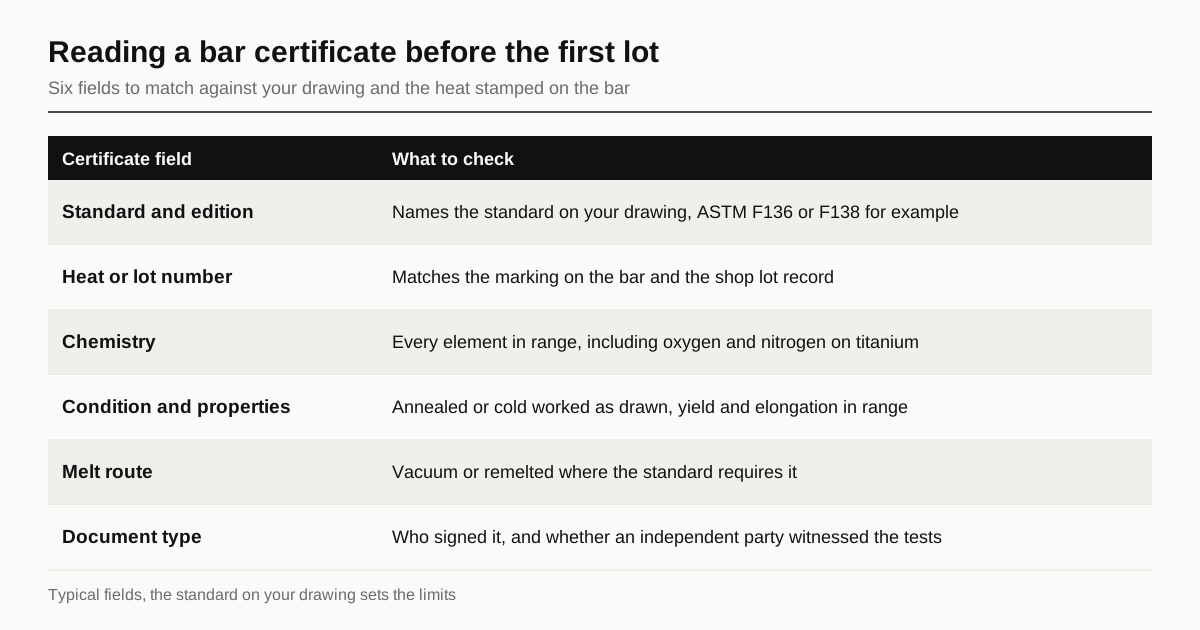
Read the certificate in this order. Each field catches a different kind of error.
| Field | What to check |
|---|---|
| Standard and edition | Names the standard on your drawing, in the edition your drawing or specification allows |
| Heat or lot number | Matches the marking on the bar or its tag, and the number that goes into the shop lot record |
| Chemistry | Every element listed and within the standard’s limits, including oxygen, nitrogen and hydrogen on titanium |
| Condition and properties | Annealed or cold worked as drawn, with yield, tensile and elongation in range |
| Melt route | Vacuum or remelted processing where the standard requires it |
| Document type | Who issued it and signed it, and whether an independent party witnessed the tests |
Typical fields, the standard on your drawing sets the limits.
Standard and edition
Standards are revised. A certificate that cites an old edition may still meet a newer one, and a drawing may name an edition or say “latest”. The buyer’s specification should say which. If the certificate and the drawing do not match, the shop asks before it cuts.
Heat or lot number
The heat number is the thread that ties everything together. It is stamped, tagged or etched on the bar, written on the certificate and copied into the shop’s lot record. If a bar arrives with no marking, or a marking that does not match the paper, the lot has no traceability from the start. A shop that cuts bar into short blanks should mark each piece or keep each in a tagged tray.
Chemistry
The chemistry block lists the elements and their measured values. Compare each to the limits in the standard. On titanium alloys, the interstitials, oxygen, nitrogen, hydrogen and carbon, matter more than the main alloying elements, because they affect strength and fatigue. For ELI grades the oxygen limit is lower than for standard grades. Our guide on Ti-6Al-4V ELI against Grade 4 titanium shows where that difference matters.
Condition and properties
Bar comes in conditions such as annealed, cold worked, stress relieved or solution treated and aged. The drawing names the one required. Properties on the certificate come from tests on the heat in that condition. Check yield, tensile and elongation against the standard. A cold-worked bar has higher strength and lower elongation than an annealed one, and mixing them up affects machining and the final part.
Melt route
Some standards require remelting, such as vacuum arc remelting for titanium or vacuum melting for stainless steel implant grades. Others do not. The certificate may state the melt route, and some buyers ask for it explicitly. If your design file assumes cleanliness that depends on the melt route, put it on the drawing.
Document type
The common European document types are named in EN 10204. A type 2.1 document is a declaration of compliance and a type 2.2 is a test report that is not tied to specific inspection of your lot. A type 3.1 certificate gives test results from the producer’s authorized inspection representative, who is independent of the production department. A type 3.2 certificate is also validated by an independent inspector. Many implant drawings call for 3.1 as a minimum. Whichever applies, the document should be signed and tied to the heat.
Common problems on the first lot
These come up repeatedly.
- The certificate covers a different size or a different heat. A trader mixes stock and sends the paper from another bar.
- A certificate of conformance replaces a test report. It states compliance without numbers.
- The edition is old or missing. Nobody checks until an audit.
- The bar is not marked. The lot record has to guess.
- A distributor re-issues the certificate. The paper no longer shows the producer’s data, and the chain of custody is harder to follow.
- Properties are in a different condition from the one drawn.
A shop that buys from the producer or from an approved distributor, and that checks the certificate against the purchase order on receipt, avoids most of these. The general rules for purchasing from approved sources sit in ISO 13485 clause 7.4, and each device company sets its own supplier controls.
Questions to ask a shop before the first lot
- Where do you buy bar, and is the source on an approved list?
- What document type do you require with each heat?
- How do you check the certificate on receipt, and who does it?
- How is each blank marked after cutting?
- Do you run a positive material identification check? A handheld analyser confirms alloy family on receipt. It does not replace the certificate.
- How long do you keep certificates and lot records? The device company’s retention rule decides.
- What happens to leftover bar? It should keep its marking and its heat number, or be scrapped.
Our guide to the quality agreement with a machine shop shows where clauses on purchasing and records go.
Who owns which check
The shop checks that the bar it bought meets the purchase order. The device company decides what the purchase order has to say and how much incoming verification it wants on top. A buyer should not assume that “ISO 13485 shop” means every certificate is read. Our guide to the ISO 13485 certificate scope explains what a shop’s certificate does and does not cover. We do not review certificates for a buyer and we do not hold any ourselves.
Cost of getting it right
Certified medical bar costs more than commercial bar, and the paper adds time. A shop that buys per job pays a premium for small quantities and may wait weeks for a heat. Minimum order quantities push some shops to buy a full length and keep the leftover, which is fine as long as marking survives. Buyers can lower cost by agreeing a common alloy and size range across parts so that one purchase covers several drawings.
Next step
Before the first lot, send the shop three things: the standard and edition for each material, the document type you expect and the marking you want on blanks. Ask the shop to confirm in writing and to send the certificate for the heat it intends to use before it cuts.
We match buyers with machining suppliers and the buyer pays us nothing. We do not supply bar and we do not qualify a supplier for you, because that stays in your own quality system. To send a drawing, request a quote and we reply within 24 business hours.
See also: how to read an ELI chemistry report, element by element, with the test method behind each.
Sources
- ASTM F138, wrought 18chromium-14nickel-2.5molybdenum stainless steel bar and wire for surgical implants
- ASTM F136, wrought titanium-6aluminum-4vanadium ELI alloy for surgical implant applications
- ISO 13485:2016, medical devices, quality management systems (clause 7.4, purchasing)
Standards and regulations change. Check the current text at the source before you rely on it in a submission.
Frequently asked questions
What does medical grade mean on a bar of metal?
On its own, nothing. It is a sales phrase, not a standard. A bar is medical grade for your part when its certificate shows the standard named on your drawing, the right edition and chemistry and properties that meet the limits. Ask for the standard by number and read the certificate against it.
Is a certificate of conformance enough?
Usually not for an implant. A certificate of conformance is a statement that the material meets a specification. A mill test report shows the actual chemistry and test results for the heat. Most implant drawings call for the test report, tied to the heat number on the bar.
Should the shop test incoming bar itself?
Many shops confirm the alloy on receipt with a handheld analyser or a quick check, and some send a sample to an outside lab. That check supports the certificate and does not replace it. The device company decides in its quality agreement how much incoming testing it expects.
Need a quote for this part?
Send the drawing. We match you with up to 3 medical machining suppliers and reply within 24 business hours.
Get matched with a medical machining supplier