Guides / Materials
Ti-6Al-4V ELI vs CP Titanium Grade 4: Which One Goes on a Medical Part Drawing
October 26, 2026
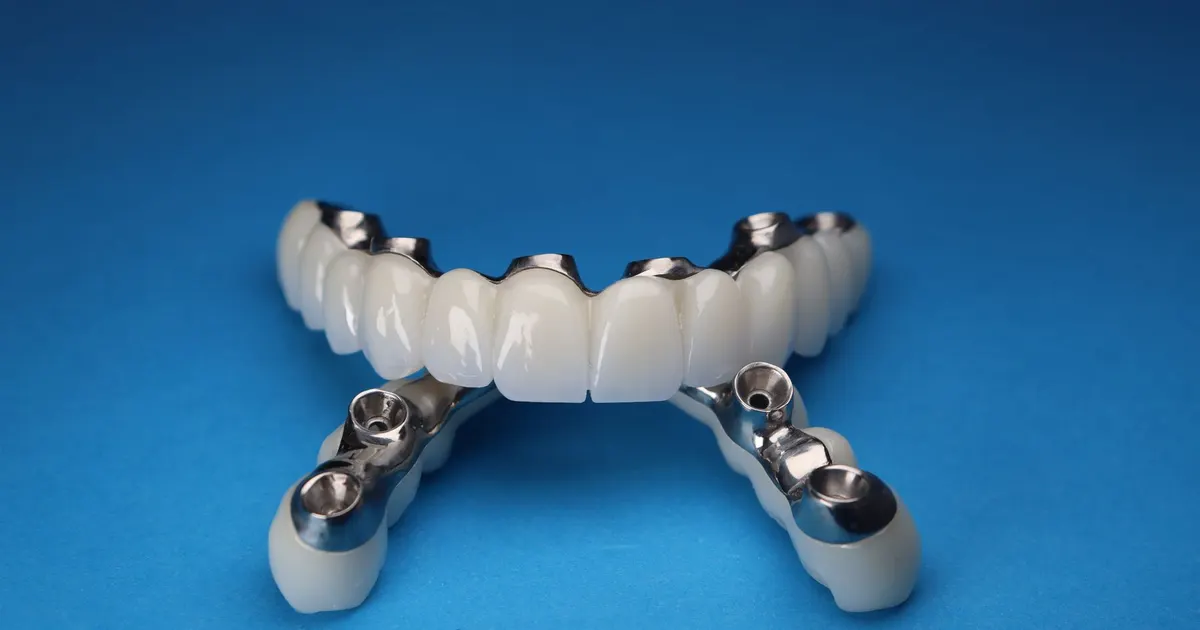
Two titanium materials come up again and again on machined implant and instrument drawings: the alloy Ti-6Al-4V ELI and the commercially pure Grade 4. They look alike, they machine in similar ways and they cost different amounts. This guide compares them on what matters at the drawing, the machine and the quote.
What each one is
Ti-6Al-4V ELI is a titanium alloy with about six percent aluminium and four percent vanadium. ELI stands for extra low interstitials, meaning tighter limits on oxygen, iron and other elements than the standard alloy. ASTM F136 covers it for surgical implants.
CP titanium Grade 4 is commercially pure, or unalloyed, titanium, with the highest oxygen content of the four common grades and therefore the highest strength among them. ASTM F67 covers unalloyed titanium for surgical implants, and Grade 4 is the strongest grade in that standard.
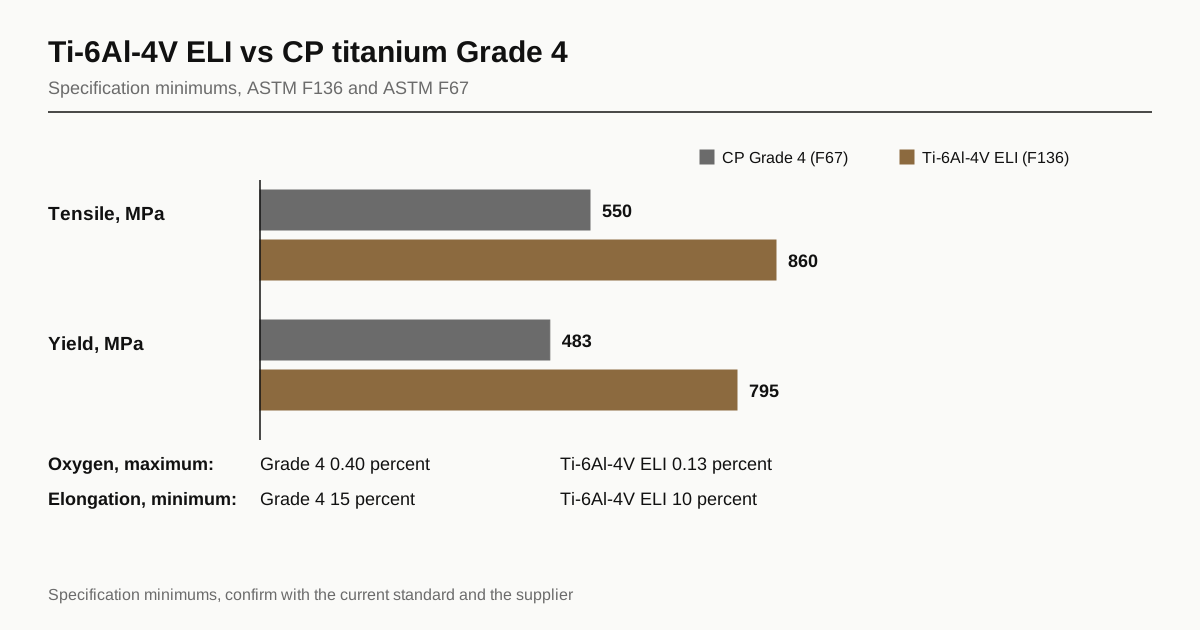
The numbers that differ
| Property | CP Grade 4, ASTM F67 | Ti-6Al-4V ELI, ASTM F136 |
|---|---|---|
| Tensile strength, minimum | 550 MPa | 860 MPa |
| Yield strength, minimum | 483 MPa | 795 MPa |
| Elongation, minimum | 15 percent | 10 percent |
| Oxygen, maximum | 0.40 percent | 0.13 percent |
| Alloying elements | None | Aluminium and vanadium |
| Elastic modulus, typical | About 105 GPa | About 114 GPa |
The strength figures are specification minimums, not typical test results, and the standards list the conditions they apply to. Read the current edition of each standard before you design to a number.
Two points stand out. The alloy is about half as strong again, and the pure grade is more ductile. Elastic modulus is close enough that stiffness is not a deciding factor between them.
Where each tends to be used
Use follows strength and design, and the device company makes the choice.
- CP titanium Grade 4. Dental implants and abutments, many plates and meshes, parts where forming matters and where the load per cross-section is modest.
- Ti-6Al-4V ELI. Spinal screws and rods, trauma screws and nails, joint components and parts that carry cyclic load with little cross-section.
The split is a tendency and not a rule. Both are well established, and the evidence in a device file is what counts. Our titanium, 316L and PEEK guide covers how those choices sit among the other implant materials.
How they machine
Both have poor thermal conductivity, so heat stays at the cutting edge, and both react with tool material at high temperature. Past that, they behave differently.
Grade 4 is softer and gummy. It smears, builds up on the cutting edge and makes long stringy chips that tangle around the part and the tool. Sharp tools, positive geometry, good chip breaking and plenty of coolant make the difference. Thread cutting and drilling can be especially messy.
The alloy is harder and cuts with higher force. Tool wear is the main issue. Speeds are conservative, tools are changed on a plan and the shop keeps an eye on dimension drift late in a tool’s life.
Neither material is easier. A shop that quotes one at a rate it would use for the other is probably wrong in one direction. For how these differences show up in the quote, see what drives the cost of a machined medical component.
Cost
Bar cost differs, and the direction depends on the market and the size. The alloy bar is usually the more expensive of the two, and small diameters in either material can carry long lead times and minimum order quantities. Machining cost depends more on tool wear, set-up and finishing than on the bar. Our guide to titanium, 316L and PEEK makes the point that a large machining premium for ELI over standard Grade 5 deserves a question. The same attitude applies here: ask what a premium covers, whether bar, traceability or time, and ask for it as a separate line.
Strengthening, heat treatment and cold work
The two materials get their strength differently, and it shows in the supply chain.
Commercially pure titanium cannot be strengthened by heat treatment. Grade 4 gets its strength from its oxygen content and, in many products, from cold work during bar production. A bar supplied in a cold-worked condition and one supplied annealed are different purchases, and the certificate has to say which you got. Heating the finished part, for example during a process step that runs hot, can change a cold-worked bar.
The alloy can be heat treated, but implant parts to ASTM F136 are normally supplied and used in the annealed condition. That keeps the property set predictable and the certificate simple. Anything unusual in the heat-treat condition belongs on the drawing.
Colour, anodizing and surface
Both materials can be anodized, and the oxide colour comes from the film thickness, not from a dye. Shops and device companies often use colour to code sizes on a screw set. The finishing process is part of the device specification and the validation, so a change of finisher is a change that needs notification. Read UDI laser marking on machined parts for how marking interacts with these surfaces.
Galling and mixed assemblies
Titanium against titanium tends to gall: the surfaces seize and tear, especially in threads under load. That affects assembled implants with screws and plates, and it affects the fixtures and gauges a shop uses to check them. A thread gauge that galls on a titanium screw gives a false reject and can damage the part. Ask a shop how it gauges titanium threads, and whether the gauges are coated or lubricated in a way that is approved for the process.
Mixed material assemblies, such as a titanium screw in a cobalt chrome plate, bring corrosion questions that the design team assesses. A machining shop cannot answer them, and should not be asked to.
Why you cannot swap one for the other
A material change on a medical device is a design change. It touches strength, fatigue, wear, imaging, biocompatibility evidence and the regulatory file. A shop that offers to quote Grade 4 instead of ELI to save money is offering something only the device company can approve. Do the reverse check too: a drawing inherited from a stronger implant may specify the alloy on a part that never needed it, and a design review can find that. That is a decision for your engineering team, not for the quote.
What to write on the drawing
Four lines make every quote price the same material.
- Grade and standard. “Ti-6Al-4V ELI to ASTM F136” or “CP titanium Grade 4 to ASTM F67”. Never “titanium”.
- Condition. Annealed, or the condition the standard allows and your design needs.
- Certificate. A material certificate tied to the heat lot, naming the standard.
- Surface treatment. Finishing, anodizing or passivation, with its own standard.
Add a line that substitution needs written approval. How to write a medical machining RFQ covers the full list of what a shop needs to quote cleanly.
What to ask a shop
- Which of the two have you machined on parts like mine, and how recently?
- What tool life do you plan, and how is it priced?
- Where does the bar come from, and what are the lead time and the minimum order?
- How do you keep the heat lot linked to each part?
- What finishing follows machining, and who does it?
We match buyers with machining suppliers and the buyer pays us nothing. We do not machine parts, we do not choose a material for you and we do not qualify a supplier, because that stays in your own quality system. To send a drawing, request a quote and we reply within 24 business hours.
See also: chemistry reports for Ti-6Al-4V ELI, for the elements, test methods and red flags on a certificate.
Sources
- ASTM F136, wrought Ti-6Al-4V ELI alloy for surgical implant applications
- ASTM F67, unalloyed titanium for surgical implant applications
Standards and regulations change. Check the current text at the source before you rely on it in a submission.
Frequently asked questions
Is Grade 4 titanium strong enough for a load-bearing implant?
It depends on the load and the design, and the answer belongs to the device company's engineering file. Grade 4 has roughly two thirds of the tensile strength of Ti-6Al-4V ELI. It is widely used in dental implants and plates. Where a part carries cyclic load with little cross-section to spare, designers usually reach for the alloy.
Does Ti-6Al-4V ELI machine better than Grade 4?
Neither is easy. Grade 4 is softer and tends to smear and build up on the tool edge, with long stringy chips. The alloy is stronger, cuts with higher force and wears tools faster. Shops describe them as different problems, not one easy and one hard.
Can a shop quote Grade 4 when my drawing says ELI?
It should not, because the two are different materials with different standards. A drawing that names only titanium invites a quote on the cheaper one. Write the grade and the standard so every quote prices the same material.
Need a quote for this part?
Send the drawing. We match you with up to 3 medical machining suppliers and reply within 24 business hours.
Get matched with a medical machining supplier