Guides / Materials
Medical Plastics Beyond PEEK: PPSU, PEI and Acetal
October 20, 2026
PEEK gets most of the attention in medical plastics, and for good reason. It is also expensive and not always the right answer. Three other polymers show up often on medical drawings: PPSU, PEI and acetal. They suit instrument handles, trays, guides, housings and wear parts. This guide explains how they differ, how shops machine them and what the stock certificate has to say. Our earlier guide to titanium, 316L and PEEK for medical parts covers the implant side.
Where these plastics are used
None of the three is an implant grade in the way PEEK is. They sit mostly on instruments, accessories and equipment.
- PPSU. Instrument handles, sterilization trays and cases, surgical guides and housings that see many cleaning cycles.
- PEI. Instrument guides, dental trays, device housings and parts that need stiffness and dimensional stability.
- Acetal, also called POM. Gears, bushings, sliding guides, lead screw nuts and low-friction parts in equipment.
Some may touch a patient briefly, for example a reusable handle held by a surgeon. Others sit inside an instrument or machine and never do. The risk file of the device company sets what level of biological evaluation applies. ISO 10993-1 is the standard that describes that process, and the evaluation belongs to the device company.
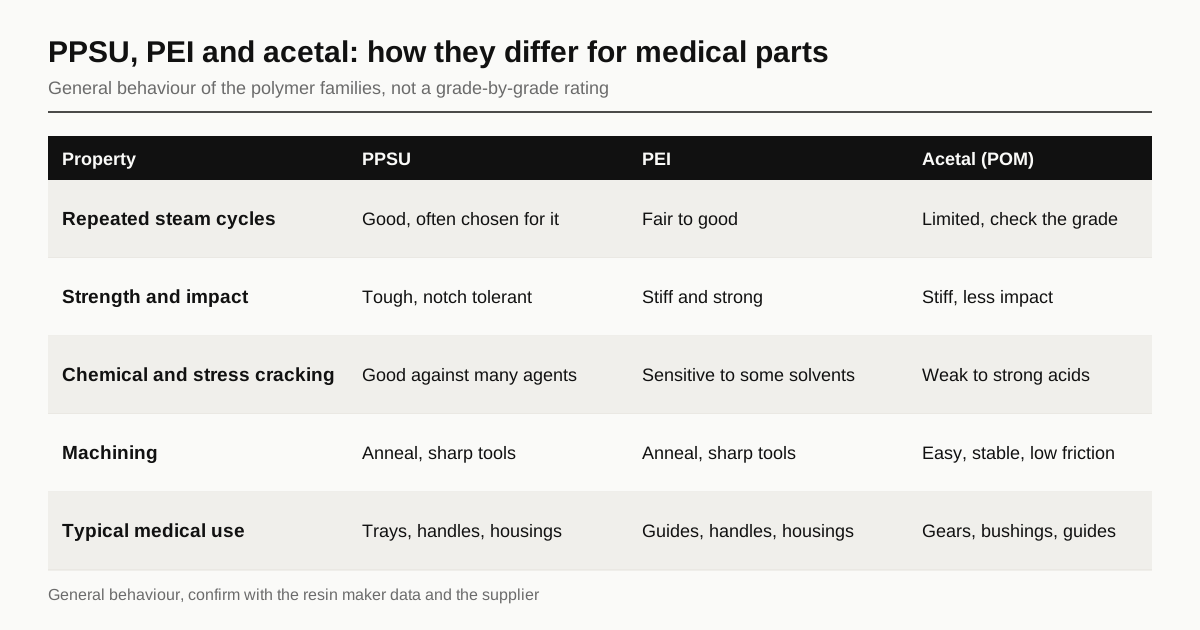
How the three differ
| Property | PPSU | PEI | Acetal (POM) |
|---|---|---|---|
| Repeated steam cycles | Good, often chosen for it | Fair to good | Limited, check the grade |
| Strength and impact | Tough, notch tolerant | Stiff and strong | Stiff, less impact resistant |
| Chemical resistance | Good against many agents | Sensitive to some solvents | Weak against strong acids |
| Appearance | Amber to opaque, dyed grades exist | Amber, dyed grades exist | White or black, many colours |
| Machining | Anneal, sharp tools | Anneal, sharp tools | Easy, stable, low friction |
| Cost of stock | High | Medium to high | Low |
General behaviour of the polymer families, confirm with the resin maker data. Each family has many grades, and the grade changes the answer.
PPSU and PEI are amorphous. They are tough, but they hold internal stress and react to certain chemicals. Acetal is semi-crystalline and has a clean, waxy feel. It cuts easily and holds size well. It does not take repeated steam as well as the other two, and strong acids and some oxidizing agents attack it.
Machining PPSU and PEI
Amorphous plastics cut cleanly with sharp tools and the right conditions. Trouble comes from stress.
- Annealing. Extruded stock carries stress. Many shops anneal a rough-machined part before the final cuts, so it does not move or crack later.
- Sharp tools with polished flutes. Tools made for plastic or aluminium work better than tools made for steel.
- Low heat. A cooling air jet or a plastic-safe coolant keeps the surface from melting.
- Compatible fluids. Some coolants and cutting oils cause stress cracking on these plastics. Ask the shop to name the fluid and to confirm it with the resin maker’s guidance.
- Careful inside corners. Sharp internal corners concentrate stress. A radius is safer and cheaper to cut.
Thin walls flex and chatter. A shop will often rough the part, release it and finish after it has rested.
Machining acetal
Acetal is one of the easiest plastics to machine. It cuts with a good finish, holds tight tolerances and does not need much cooling. The difficulties are different.
- Homopolymer and copolymer. Homopolymer is stiffer and stronger, copolymer resists chemicals and hydrolysis better. A drawing should say which one.
- Centre-line porosity. Large extruded rod can have a porous core. Thin-wall parts and sealing faces need stock without it.
- Burrs. Acetal forms stringy burrs that need trimming or a tumble process.
- Heat and chlorine. Hot water with chlorine, strong acids and some cleaners cause damage over time.
For a part that sees a lot of steam, acetal is usually the wrong choice and the drawing should say why it was picked.
Tolerance and moisture
Plastics move with temperature and with moisture. The coefficient of thermal expansion is far higher than for metals. Water absorption varies: PPSU and PEI absorb little, and acetal absorbs a small amount. A tolerance that works on aluminium may not hold on plastic if the part is measured warm or after a wet clean. Our guide to tolerances on machined medical parts explains where a tolerance stops being worth its cost, and it applies to plastic as much as to metal.
State on the drawing the temperature at which dimensions apply. For parts that have to fit a metal mate after steam sterilization, say whether the dimension applies before or after.
Stock certificates and traceability
A medical plastic certificate should name the resin maker, the grade, the lot, the form of stock (rod, plate or tube) and the date. Ask for:
| Item | What to look for |
|---|---|
| Resin grade | Exact grade name, not just “PPSU” |
| Lot and date | Ties the finished parts to the stock |
| Colour and additive | Pigments and fillers change both properties and biocompatibility data |
| Form of stock | Rod, plate or tube, plus the maker’s process |
| Supporting data | Biocompatibility or extractables data if the grade carries it |
If the resin maker’s test data was developed on the neat resin, a coloured or filled version may not be covered. The device company decides whether the data transfers.
Cleaning and finishing
Plastics trap oil and dust in tool marks, so a cleaning step after machining is common. The cleaning agent has to suit the polymer, as some solvents craze PPSU and PEI. Laser marking can discolour or melt plastics, and the shop should prove a mark on sample parts before it applies to a lot. Our guide to UDI laser marking covers marking on metals, and plastics need their own test.
Colour matching on handles and trays is a separate matter. Pigment batches vary, so colour is agreed with a sample.
Cost drivers
The stock is the biggest line for PPSU, because medical grade resin is expensive. Annealing, conditioning and slow, careful cuts add cycle time on all three. Acetal is the cheapest to buy and to cut. A drawing that picks PPSU for a part that never sees a steam cycle spends money that a device company may be able to save, and a drawing that picks acetal for a handle that goes through the autoclave loses it on returns.
Sterilization method changes the answer
Steam is not the only route. Reusable plastic parts see steam in an autoclave. Some see low-temperature methods such as ethylene oxide or hydrogen peroxide gas plasma, and others go through chemical disinfection. A plastic that does well in steam may react to a peroxide process, and the opposite also happens. The device company knows the method and states it in the drawing or specification. A shop cannot choose a polymer without that information, and a buyer should not ask for a quote before it is known.
Next step
Before you request quotes, list the cleaning and sterilization steps the part sees in service, the chemicals it meets and the dimensions that have to hold after them. Ask each shop how it anneals, which coolant it uses and what lot record it keeps for stock.
We match buyers with machining suppliers and the buyer pays us nothing. We do not machine plastics and we do not qualify a supplier for you, because that stays in your own quality system. To send a drawing, request a quote and we reply within 24 business hours.
See also: PFAS and fluoropolymer parts in medical devices, for PTFE-filled grades and what buyers ask now.
Sources
- ISO 10993-1, biological evaluation of medical devices, evaluation and testing within a risk management process
- ASTM F2026, polyetheretherketone (PEEK) polymers for surgical implant applications
Standards and regulations change. Check the current text at the source before you rely on it in a submission.
Frequently asked questions
Which of these plastics survives repeated steam sterilization best?
PPSU is the usual choice for parts that go through many steam cycles, such as instrument handles and sterilization trays. PEI copes with steam but is more sensitive to some cleaning agents. Acetal is the weakest of the three on repeated steam. The resin maker publishes cycle data for each grade, and a device company should confirm it against its own cleaning process.
Do I need a medical grade of these plastics?
That depends on what the part touches and on the device maker's risk file. Resin makers sell grades with documented control of the formulation and supporting biocompatibility data, and those grades cost more. General industrial grades do not come with that paper. The choice belongs to the device company, not the machine shop.
Why do some plastic parts crack after machining?
Amorphous plastics such as PPSU and PEI hold stress from extrusion and from cutting, and some cutting fluids or cleaners attack them. The result can be crazing or cracks that appear days later. Annealing before finish machining and a compatible coolant lower the risk.
Need a quote for this part?
Send the drawing. We match you with up to 3 medical machining suppliers and reply within 24 business hours.
Get matched with a medical machining supplier