Guides / Materials
UHMWPE Machining for Bearing Surfaces and Liners
October 27, 2026
Ultra-high-molecular-weight polyethylene, usually shortened to UHMWPE, is the standard bearing material against metal in joint replacements. Acetabular liners, tibial inserts and patellar buttons are all machined or moulded from it. The plastic cuts easily and still causes trouble. This guide explains why it moves, how shops control it and what a buyer should read on the certificate before the first lot.
Where UHMWPE appears
Orthopedic bearings are the main use. The polymer sits against a metal or ceramic head and takes load and wear for years. Typical machined parts include:
- Acetabular liners that sit inside a metal shell
- Tibial inserts for knee systems
- Patellar components
- Spinal disc cores and similar articulating parts
- Bushings and wear pads in instruments and fixtures
Many of these are compression moulded to near shape and finished by machining. Others are cut from extruded or moulded bar. Which route applies is set by the device design and the supplier of the polymer.
Why it moves
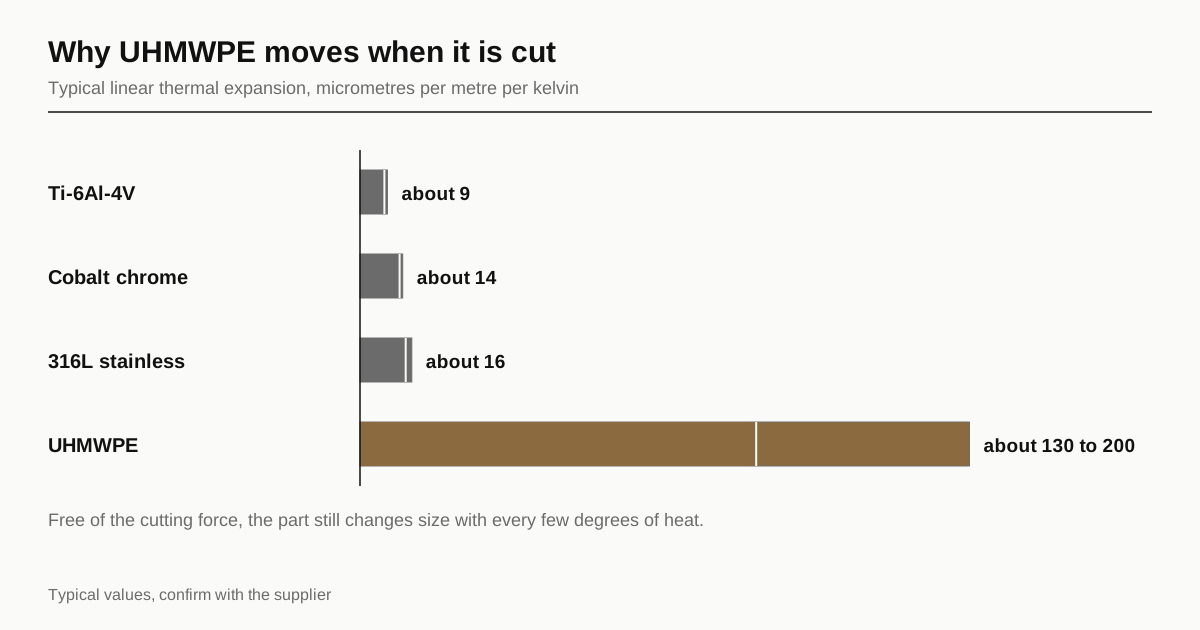
UHMWPE has a very low modulus and a very high thermal expansion compared with the metals around it. The chart at the top of this guide shows typical linear expansion in micrometres per metre per kelvin. The polymer expands more than ten times as much as titanium alloy for the same temperature change. A liner measured in a warm inspection room and again in a cool one will not read the same.
| Behaviour | What it does at the machine |
|---|---|
| High thermal expansion | Size shifts with room, coolant and spindle heat |
| Low stiffness | Part flexes away from the tool and under clamps |
| Creep | Clamp load leaves a permanent dent or flat |
| Stress relaxation | Moulded or extruded stock moves after material is removed |
| Low surface hardness | Chips and tools leave marks, and metal chips embed |
Typical behaviour, confirm with the supplier and the resin maker data. The practical answer is to treat UHMWPE as a part that has to settle before it is measured.
Controlling heat and stress
Experienced shops follow a few habits.
- Stock is conditioned. Bar sits in the shop long enough to reach room temperature before the first cut.
- Roughing and finishing are separated. A rough pass takes most of the material, the part rests and the finish pass takes a light cut. This lets stress relax before the final size is cut.
- Sharp tools with a generous rake. A sharp edge cuts cleanly and generates little heat. A dull edge pushes and smears.
- Light, even clamping. Soft jaws, a collet with a sleeve or vacuum fixturing keep clamp marks and creep down.
- Temperature control at inspection. Parts are measured at a stated temperature, not straight off the machine.
Cutting fluid needs thought. Many bearing parts are cut dry or with air, or with a fluid that has been approved as leaving no residue. A drawing should state the allowed fluids and the cleaning that follows. Our guide to cleaning validation for machined implants covers how residue limits get set.
The bearing surface
The surface that articulates against the metal head is the part of the liner that matters most. Drawings usually call out a smooth finish and a form tolerance on the bearing radius. A machined surface is typically followed by a polishing or burnishing step on liners, and the finish is checked with a profilometer. The values vary by design, so read the drawing and do not rely on a general number.
The back side of a liner, where it locks into a metal shell, has its own requirements. Locking features, snap rings and tapers are fit-critical. A small error there causes micromotion against the shell, which a device company will want to avoid. These features are checked with gauges or a CMM at the temperature the drawing states.
Contamination
UHMWPE is soft. Metal particles from a nearby operation can embed in a polymer surface and stay there through washing. A good shop runs polymer on a dedicated machine or a cleaned machine, with its own tools, fixtures and chip handling. Ask where the work is done and how the machine is cleaned between metal and polymer jobs.
Other contamination sources:
- Cutting fluid or coolant residue
- Handling with ungloved hands or with talc gloves
- Dust and chips between operations
- Packaging that sheds fibres
The buyer’s cleanliness requirement should be on the drawing or in the quality agreement, and our guide to the quality agreement with a machine shop shows where.
Oxidation, irradiation and sterilization
UHMWPE oxidizes over time, and oxidation lowers wear performance. The risk depends on how the polymer was processed and sterilized. Conventional UHMWPE has been sterilized by gamma radiation in air in the past, which promotes oxidation. Current practice uses gamma in an inert atmosphere, ethylene oxide or gas plasma for many parts, and highly cross-linked grades are heat treated or stabilized to reduce oxidation. ASTM F2102 describes a method for measuring oxidation in UHMWPE.
This sits mostly with the device company and the stock supplier, not the machine shop. The shop still needs to know what the drawing assumes, for example whether the part is machined from irradiated stock and whether a later sterilization step is planned. Our guide to sterilization for machined implants explains how that handoff works.
Certificates and traceability
A UHMWPE bar certificate should name the standard, the resin grade, the manufacturing route, the lot and the date. ASTM F648 is the specification for powder and fabricated forms for surgical implants. For a part designed to it, the certificate and the lot record follow the stock from the producer to the machine to the final box.
| Certificate item | Why it matters |
|---|---|
| Standard and revision | Matches the drawing |
| Resin grade and lot | Sets the base material and its history |
| Processing route | Moulded, extruded, irradiated or stabilized |
| Date of manufacture | Shelf life and storage time before machining |
| Lot number on the stock | Ties the finished parts to the bar |
Bar stock stays in its original packing until needed, away from heat, and carries its lot tag on the bar.
Cost drivers
Polymer is cheap to cut and expensive to make right. The cost sits in three places: the certified stock, the number of conditioning and finishing passes and the cleanliness controls. A dedicated cell or a cleaned machine adds time. Tight bearing tolerances increase inspection time. Annual volume matters because a liner family has many sizes, and each size has its own program and fixture.
Inspection
Measuring a soft, expanding part needs care. Contact probes press into the surface and read small. Optical and non-contact methods avoid that, and a CMM with a light probe force can work. Temperature at inspection has to match the drawing, and a part straight off the machine reads differently from one that has rested. The drawing should name the measuring method for the bearing radius, the form tolerance and the locking features. If the shop and the buyer measure differently, they will disagree on the same part.
Next step
Before you request quotes, write down the temperature at which your dimensions apply, the allowed cutting fluids, the cleaning requirement and the stock specification. Ask each shop whether UHMWPE runs on a dedicated machine and how parts rest between roughing and finishing.
We match buyers with machining suppliers and the buyer pays us nothing. We do not machine polymer parts and we do not qualify a supplier for you, because that stays in your own quality system. To send a drawing, request a quote and we reply within 24 business hours.
Sources
- ASTM F648, ultra-high-molecular-weight polyethylene powder and fabricated form for surgical implants
- ASTM F2102, guide for evaluating the extent of oxidation in UHMWPE fabricated forms intended for surgical implants
Standards and regulations change. Check the current text at the source before you rely on it in a submission.
Frequently asked questions
Is UHMWPE hard to machine?
It is easy to cut and hard to hold to size. The material is soft, so it cuts with low force, but it expands with heat, relaxes after cutting and creeps under clamping load. Holding a bearing tolerance means controlling temperature, stress and fixturing, not just feeds and speeds.
Does the machine shop make the polyethylene?
No. The shop machines bar, sheet or a moulded blank made by a resin and stock supplier. The material certificate, the resin lot and the processing history come from that supplier, and the shop passes them on with its own lot record.
What is highly cross-linked polyethylene?
It is UHMWPE that has been irradiated and heat treated, sometimes with an antioxidant added, to reduce wear. It machines like conventional UHMWPE but carries extra processing history that a drawing and a certificate should name. Which grade a part needs is a design decision for the device company.
Need a quote for this part?
Send the drawing. We match you with up to 3 medical machining suppliers and reply within 24 business hours.
Get matched with a medical machining supplier