Guides / Technical
Wire EDM for Surgical Instrument Jaws and Cutting Features
October 28, 2026
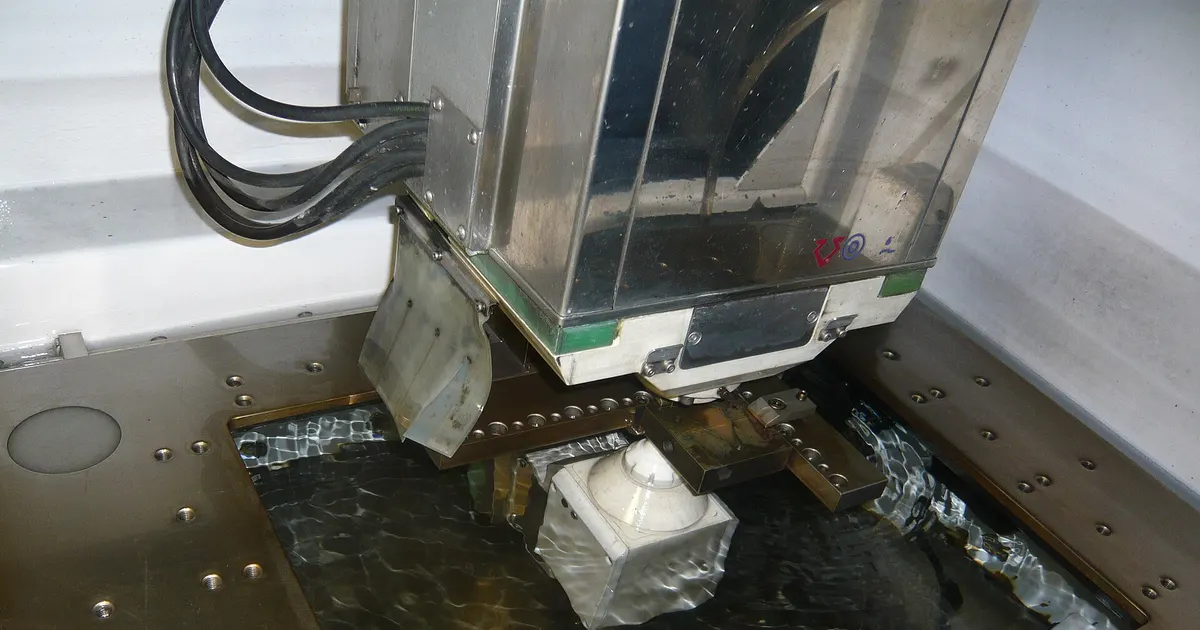
Surgical instrument jaws, graspers, teeth and cutting features are hard to machine by conventional means once the steel is hardened. Wire electrical discharge machining, usually called wire EDM, cuts them without touching the part. This guide explains what the process does, where it suits instrument features, what it leaves on the surface and what to ask a shop before you rely on it.
How wire EDM works
A thin wire, commonly around a quarter of a millimetre in diameter and finer for small work, runs through the part under tension. Electrical sparks jump between the wire and the workpiece in a bath of deionised water, and each spark removes a tiny amount of metal. The wire follows a programmed path in two axes, and often tilts for tapered cuts. The wire never touches the part, so there is no cutting force.
Three features follow from that:
- Hardness does not matter. The process cuts any conductive metal, hard or soft.
- Force does not matter. Thin walls and fine teeth do not deflect under a cutter.
- Material removal is slow. It is measured as cut area per minute, not as volume.
The part has to be conductive, and the cut has to be a through cut. Blind pockets are not possible, and the wire needs a start hole or an open edge.
Where it fits instrument parts
| Feature | Why wire EDM fits |
|---|---|
| Forceps and grasper jaws | Fine teeth and serrations cut after hardening |
| Scissor blades and cutting edges | Sharp, precise profiles with no cutter radius limit |
| Needle holder jaws | Thin, hard inserts with tight tolerances |
| Thin-walled clips and housings | No cutting force to distort the wall |
| Parts in hardened or tough alloy | Machining hardness does not limit the process |
| Small internal corners | Corner radius limited by wire size and spark gap |
The process also lets a shop stack several thin plates and cut them together, which keeps the cost per part down on repeat orders.
Heat treat first, cut after
A common route for hardened instrument steels such as 17-4 PH or 420 is to rough machine the part, heat treat it, then use wire EDM for the final profile. Cutting after heat treat avoids the distortion that heat treatment causes in a finished feature. The shop leaves stock for the EDM pass and takes the final shape from the hardened blank. If the instrument design depends on a specific hardness and condition, the drawing has to say so, because EDM leaves a surface that carries its own thermal history.
For the material side of this decision, read our guide to 17-4 PH and 420 stainless for surgical instruments.
What the process leaves on the surface
Each spark melts a tiny amount of metal. Most is flushed away, but a thin layer re-solidifies on the cut face. It is usually called the recast layer or white layer, and it has three features that matter for a medical part.
- It is harder and more brittle than the base. Micro cracks can form in it.
- The material beneath is heat affected. A thin zone below the recast layer has been tempered or re-hardened.
- The surface carries residue. A little wire material, often copper or zinc, can remain on the face.
The recast layer is typically a few micrometres thick on a finish cut and thicker on a rough cut. Treat that as a general range, not a figure. The layer matters most where a part sees cyclic load, such as a spring clip, or a corrosive environment, such as repeated steam sterilization. A buyer can specify that the layer is reduced or removed.
Skim cuts and surface finish
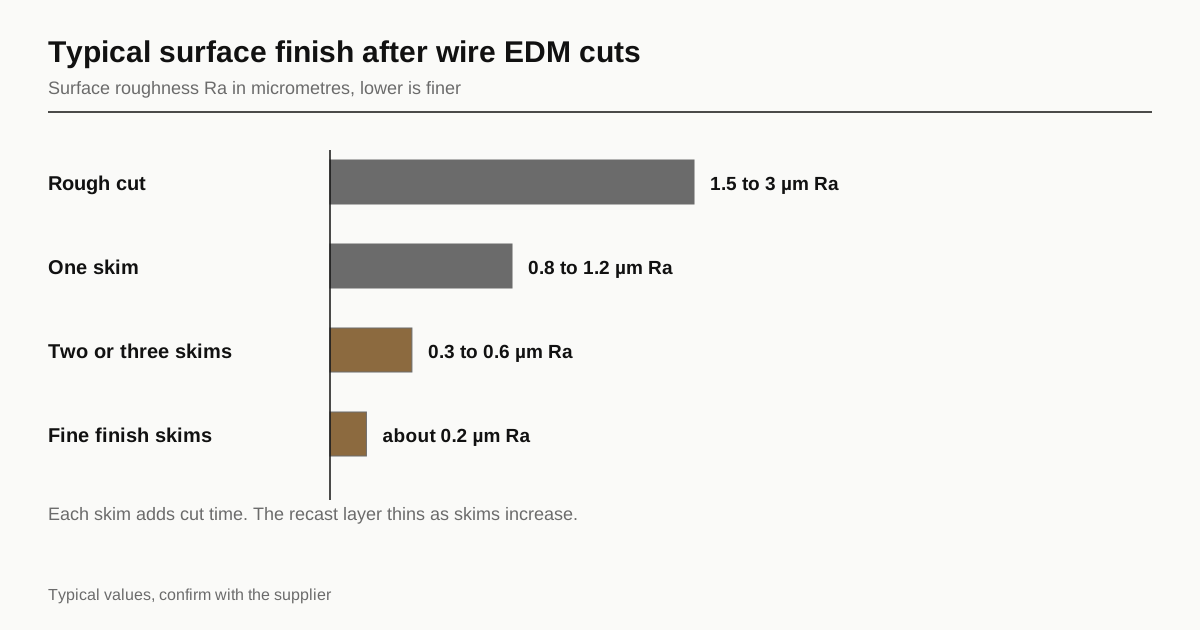
A first rough cut removes most of the material quickly and leaves a rough surface. Further passes, called skim cuts, use lower energy to refine the surface and reduce the recast layer. Each pass adds time. A typical rough cut leaves a surface in the range of one to three micrometres Ra, and several skim cuts can bring it down to a few tenths of a micrometre. Those figures vary by machine, wire, material and thickness.
| Cut | Typical surface, Ra | Relative time |
|---|---|---|
| Rough cut | About 1.5 to 3 micrometres | 1 |
| One skim | About 0.8 to 1.2 micrometres | Roughly 1.5 to 2 |
| Two or three skims | About 0.3 to 0.6 micrometres | Roughly 2 to 3 |
| Fine finish skims | About 0.2 micrometres | Several times the rough cut |
Typical values, confirm with the supplier. A cutting edge that needs a fine finish and a jaw tooth that only has to grip do not need the same number of skims.
Finishing after EDM
A shop that cuts instrument parts by EDM usually adds finishing steps. Common choices include a light abrasive or bead blast to remove the recast layer, electropolish for stainless steel and a final clean and passivation. Passivation of stainless steel instruments commonly follows ASTM A967, and our guide to passivation and electropolish covers the options. Cleaning follows, because dielectric residue and wire particles need to come off the part. See cleaning validation for machined implants for how that stage is proven.
Since the recast layer and the finishing steps both change the surface, a drawing that says only “wire cut” leaves too much open. A better drawing states the surface finish, whether the recast layer must be removed and how it will be checked.
Tolerance and accuracy
Wire EDM can hold tight tolerances. A well-run machine commonly holds around plus or minus 0.005 mm on a cut profile, and tighter with fine wire, skim passes and a stable room. Tolerance depends on thickness, wire guide condition, flushing and temperature. As with any process, a tolerance tighter than the function needs adds time and cost. Our guide to tolerances on machined medical parts explains where the cost curve bends.
Wire EDM against the alternatives
EDM is one of several ways to make a hard, fine feature, and a shop should be able to say why it chose this one.
- Milling in the soft state. Cheapest when the feature survives heat treatment without distortion, or when the part is made from a pre-hardened or non-hardening alloy.
- Grinding. Gives an excellent edge and finish on straight and simple profiles. It struggles with internal corners and complex outlines.
- Laser cutting. Fast on thin sheet and good for flat blanks. It leaves a heat affected edge and a wider kerf than fine wire EDM.
- Wire EDM. Slower, but suits complex profiles in hardened or tough material with no cutting force.
On many instruments the answer is a mix. A blank is milled, heat treated, wire cut to profile, ground at the edge and then finished. The cost sits in how many of those steps the design needs. A design that asks for a razor edge, a fine tooth pattern and a close-fitting hinge needs most of them.
Drawing gaps that cause trouble
Four gaps show up often on EDM-cut instrument parts.
- No surface requirement. Without a finish callout, a shop picks the number of skims that fits its price.
- No statement on the recast layer. If it matters to your risk file, it has to be on the drawing or in the specification.
- Heat-treat condition left open. The shop needs to know whether to cut before or after hardening, and what hardness to expect.
- Sharp internal corners. A wire has a radius, so an internal corner cannot be perfectly sharp. A drawing that shows one needs a radius note.
These gaps are cheap to close before the quote and expensive to close after a first lot.
What to ask a shop
- How many skim cuts do you plan, and what surface do they give?
- How do you deal with the recast layer? Reduced by skims, removed by a named process or left, with the reason.
- What wire and what machine will cut my part? Fine features need fine wire and a machine that supports it.
- How will you hold the part? Thin parts distort under clamping, and fixturing affects the result.
- What finishing and cleaning follow? The plan should name each step.
- Do you validate the process? If the surface condition affects performance, validation may apply, as covered in our IQ, OQ and PQ guide.
We match buyers with machining suppliers and the buyer pays us nothing. We do not run EDM and we do not qualify a supplier for you, because that stays in your own quality system. To send a drawing, request a quote and we reply within 24 business hours.
Sources
- ASTM A967, chemical passivation treatments for stainless steel parts
- ISO 13485:2016, medical devices, quality management systems (clause 7.5.6, validation of processes)
Standards and regulations change. Check the current text at the source before you rely on it in a submission.
Frequently asked questions
Why use wire EDM instead of milling for instrument jaws?
Wire EDM cuts hardened material without cutter force, so it can make thin walls, sharp internal corners and fine teeth after heat treatment, when milling would deflect or wear out tools. It is slower per feature than milling in soft material, so it earns its place where hardness or geometry rules milling out.
What is the recast layer and does it matter?
It is a thin layer of resolidified metal left on the cut face by the spark. It is harder and more brittle than the base metal and can carry micro cracks. On a part under cyclic load or in a corrosive environment, it is often removed or reduced by skim cuts and a finishing step.
Can wire EDM cut titanium and cobalt chrome?
Yes, any electrically conductive metal. That makes it useful for hard or work-hardening alloys. The same recast-layer questions apply, and the finishing plan should be agreed with the buyer.
Need a quote for this part?
Send the drawing. We match you with up to 3 medical machining suppliers and reply within 24 business hours.
Get matched with a medical machining supplier