Guides / Technical
Thread Whirling vs Single-Point Threading on Medical Screws
October 25, 2026
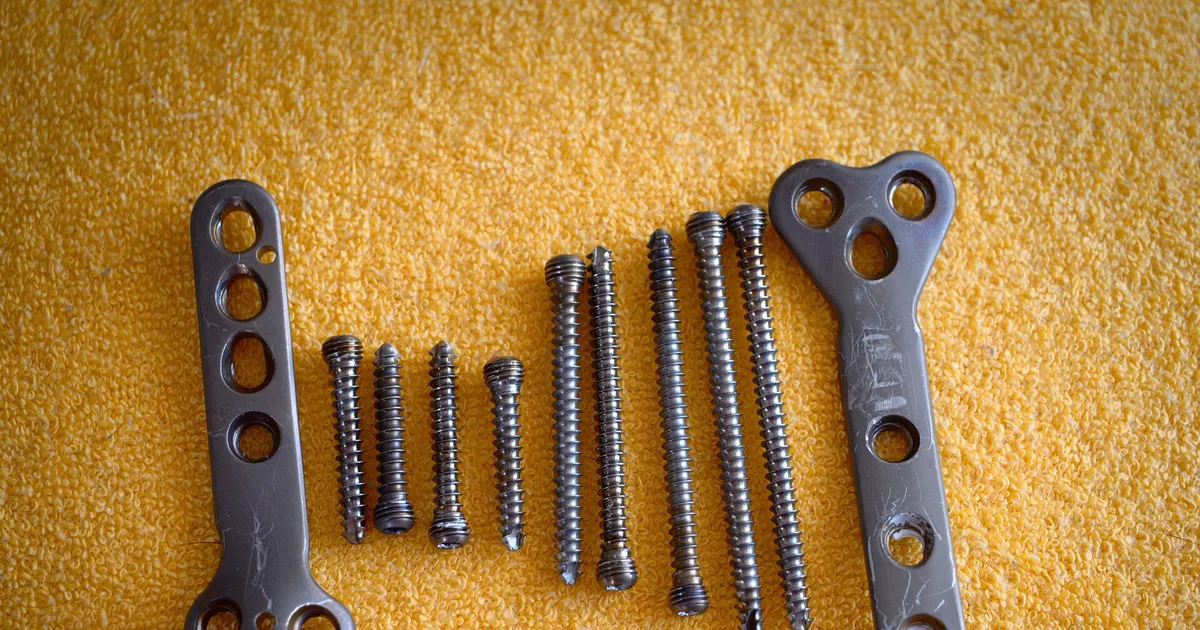
Bone screws are mostly thread by area, and how the thread is cut decides cycle time, surface finish and how many parts survive the lot. Two methods dominate cut threads on slender medical screws: single-point threading and thread whirling. This guide explains how each works, where each wins and what to ask a shop before it quotes.
How single-point threading works
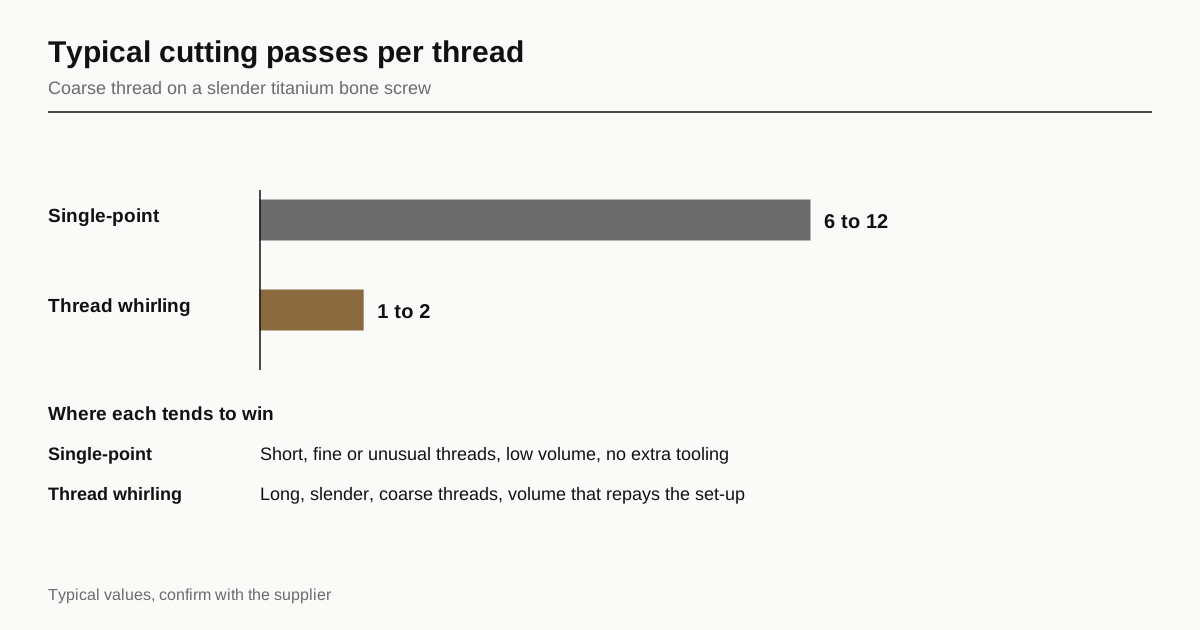
A single-point tool is a small insert with the shape of the thread. The lathe spindle turns the part, the tool moves along the axis at a feed equal to the thread pitch, and the tool cuts one helical groove. The tool takes several passes, each a little deeper, until the thread reaches full depth.
The method needs nothing beyond a normal lathe and a threading tool. That makes it flexible: it can cut almost any thread form, any pitch and any length. The price is time, and on a slender part the cutting force pushes the screw sideways with each pass.
How thread whirling works
Thread whirling puts a ring of carbide inserts around the bar. The ring rotates at high speed, and the part turns slowly. The inserts, set off-centre and tilted to the helix angle, cut the thread in one pass or very few. On a Swiss-type machine the bar passes through the ring, so the thread is cut close to the guide bushing, where the part is best supported.
The method needs a whirling unit, a tool ring matched to the thread form and a machine with the spindle and axis control to run it. Setup takes longer than a plain threading cycle, and the ring is specific to a pitch and form. Once running, it cuts a coarse thread in a fraction of the time.
Where each method wins
| Factor | Single-point | Whirling |
|---|---|---|
| Passes per thread, typical | Many, often 6 to 12 | One to two |
| Slender, long threaded section | Part flexes with each pass | Cut close to support |
| Coarse pitch, bone-screw style | Slow | Strong fit |
| Fine pitch, short thread | Fine | Little advantage |
| Special form or odd pitch | Flexible | Needs a matching ring |
| Low volume | Cheaper | Setup rarely pays back |
| Tooling needed | Standard inserts | Whirling unit and ring |
These are typical comparisons, not promises. A shop that runs a screw family weekly can make either method work.
Surface finish and thread quality
Whirled threads tend to show an even, repeatable surface because the insert engages the part gently at high surface speed, and each insert takes a small chip. Single-point threads depend more on the tool edge, the feed per pass and how well the shop controls chatter. On titanium, built-up edge and galling can leave a torn flank if speeds and coolant are wrong. Both methods leave burrs at the thread start, the thread runout and any cross hole, which a separate step has to remove. See our guide on deburring medical parts.
Thread form for bone screws is governed by standards such as ISO 5835 for hex-drive metal bone screws and by ASTM F543 for the screws and their test methods. The standards set the geometry and what a test must show, not the process that cuts it. If a shop switches from one process to the other and the geometry still meets the standard, the part is within the standard but not necessarily within your validated process.
Material matters more than method
Titanium alloys such as Ti-6Al-4V ELI cut with a long, stringy chip and low thermal conductivity. Heat stays in the cutting edge, so tool life falls sharply with speed. Stainless steel such as 316L work-hardens and tends to smear. Cobalt chrome wears inserts quickly. A whirling ring spreads the work across several inserts, which can help with tool life on the harder alloys, but the right insert grade and coolant delivery decide the result. Our titanium, 316L and PEEK guide covers the bar stock side.
What to ask a shop
- Which process do you plan for this thread, and why? A good answer refers to length, pitch and volume.
- Is the whirling unit installed on the machine that will run my part? Some shops outsource whirling to another site, which changes the supply chain.
- How will you inspect the thread? Go and no-go gauges, an optical comparator or a thread measuring system, with the plan for each lot.
- Where do burrs form and how are they removed? The answer should name the step, the method and the acceptance check.
- What happens if you change process later? The answer should be a written notification before the change, not after.
For how the thread sits next to cannulation and drive geometry in the price, read what a bone screw quote hangs on.
Where thread rolling fits
A third method sometimes enters the conversation. Thread rolling forms the thread by pressing hardened dies into the bar and displacing material, so no chip is made. It is fast, it leaves a smooth flank and it works well on fine threads in ductile material. It struggles on high-strength alloys, on sharp coarse forms with deep roots and on parts where the displaced material has nowhere to go. Many bone screw designs are cut for those reasons, and some designs use rolling. If your drawing or your regulatory file names one process, the shop has to follow it. If it names none, ask the shop what it plans and why, then confirm that the plan matches what was used on any test specimens in your file.
Failure modes worth knowing
Four problems account for most rejected screw threads on implant alloys.
- Torn or smeared flanks. Titanium and stainless steel stick to the tool when speed, feed or coolant is wrong. The flank looks rough under magnification and the screw may bind in its test block.
- Burrs at the start and runout. A burr that detaches in the body is a clear risk. Both methods leave them.
- Chatter marks on slender parts. Visible as a regular pattern on the thread flank, and often a sign of a loose guide bushing or a worn tool.
- Pitch drift over a long thread. A thread cut with a worn tool or in a warm machine can finish at a slightly different pitch than it began. A gauge that checks only a short section will miss it.
None of these depends on the method alone. They depend on how well the shop controls tool wear, coolant and inspection, which is why the plan for each lot matters as much as the process name on the router.
Inspection of cut threads
A screw thread has several characteristics that all matter: major diameter, pitch diameter, pitch, flank angle and root radius. Inspection plans often combine a functional gauge with a periodic optical check of the profile. Gauges answer the question of fit. They do not show a torn flank or a small root radius that raises stress. A profile projector or optical comparator at regular intervals shows both. For critical screws, ask whether the plan includes a section or a profile check on first articles.
If your drawing calls out a thread class, check that the shop reads it the same way you do. Thread classes and tolerance classes differ between metric, unified and the special forms used on bone screws.
Making the call
Choose single-point when the thread is short, fine, unusual or low in volume, or when the shop has no whirling unit. Choose whirling when the screw is long and slender, the thread is coarse and the volume repays the setup. If you are not sure, ask two shops for both methods and compare cycle time, setup and inspection.
We match buyers with machining suppliers and the buyer pays us nothing. We do not machine parts and we do not qualify a supplier for you, because that stays in your own quality system. To send a screw drawing, request a quote and we reply within 24 business hours.
Sources
- ISO 5835, implants for surgery, metal bone screws with hexagonal drive connection
- ASTM F136, wrought Ti-6Al-4V ELI alloy for surgical implant applications
Standards and regulations change. Check the current text at the source before you rely on it in a submission.
Frequently asked questions
Is thread whirling better than single-point threading for bone screws?
On long, slender screws with coarse threads, usually yes, because the cut happens close to the support and takes few passes. On short parts, fine pitches or low volumes, single-point threading is often cheaper because it needs no special tool. Neither wins everywhere.
Does whirling change the strength of the thread?
Both methods cut the thread, so neither cold-works it the way thread rolling does. The strength comes from the bar and the thread form. Fatigue behaviour depends on root radius and surface finish, which is a question for the design and for test data, not for the process name.
Can a shop switch from single-point to whirling without telling me?
It should not. A change of thread process alters the surface, the tool marks and sometimes the root form, so it belongs in the change-notification clause of the quality agreement, and a first article under the new method should be inspected.
Need a quote for this part?
Send the drawing. We match you with up to 3 medical machining suppliers and reply within 24 business hours.
Get matched with a medical machining supplier