Guides / Technical
Laparoscopic and Endoscopic Instrument Parts: Machining Notes
October 17, 2026
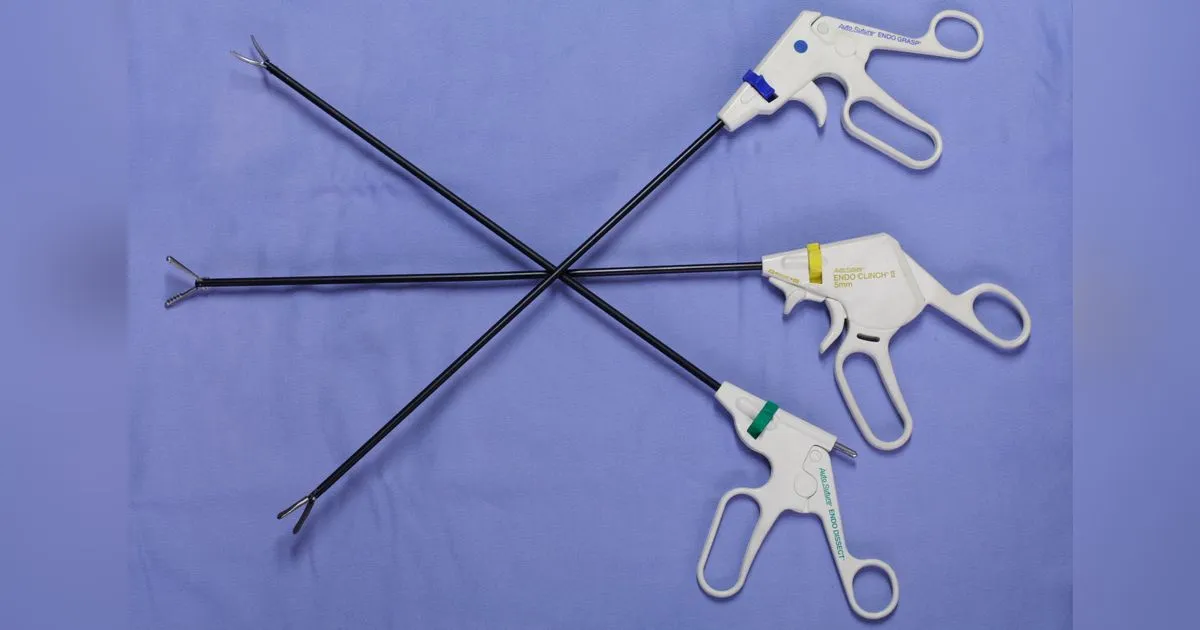
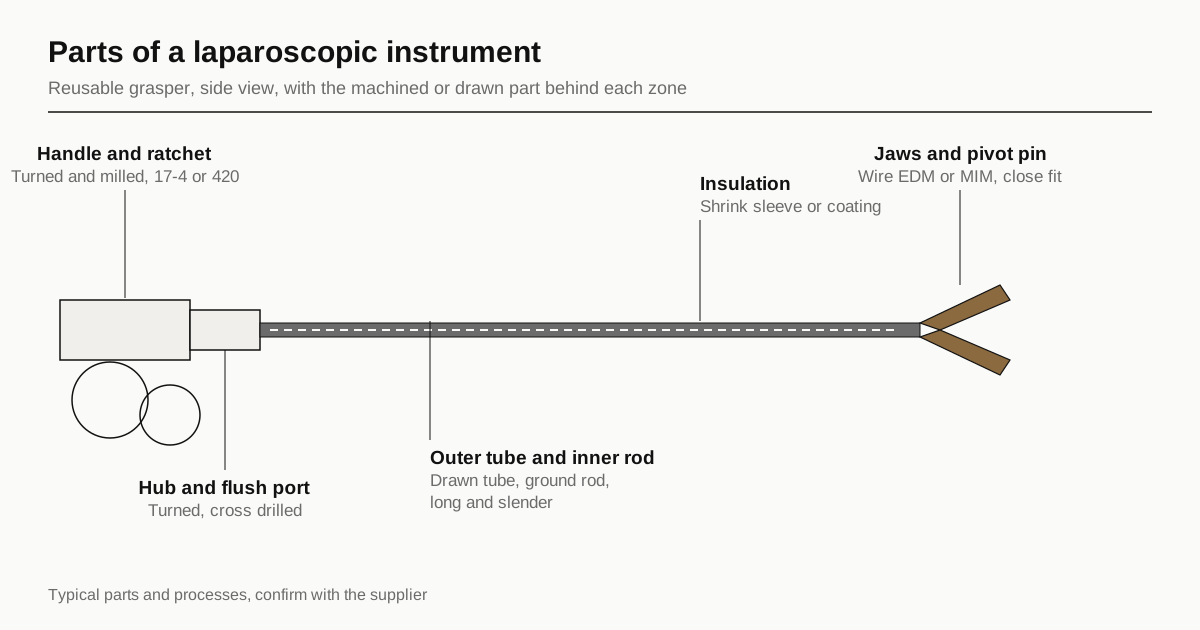
A reusable laparoscopic instrument looks like one object. It is a stack of parts: a handle, a ratchet, a hub, an outer tube, an inner rod, an insulating sleeve and a pair of jaws. Each part is made by a different process, and each fails in its own way after a few hundred cleaning cycles. This guide walks through the parts, how they are made and what a buyer should ask a shop.
What the instrument has to do
The surgeon works through small incisions with a tool whose working end is 30 to 45 cm from the hand. The shaft is long and narrow, often about 5 mm in diameter and sometimes 3 mm or 10 mm. A push rod inside the shaft carries motion from the handle to the jaws. Some instruments rotate at the shaft, and many carry electrical energy through the metal, which brings in insulation.
For a reusable design the part has to survive cleaning, steam sterilization and handling. For a buyer, that adds three questions on top of fit and function: can it be cleaned, does it corrode and does the insulation hold?
Parts and processes
| Part | Typical material | Typical process |
|---|---|---|
| Handle body and ratchet | 17-4 PH or 420 stainless | Turn, mill, heat treat, grind |
| Hub and rotation knob | 303, 304 or 316 stainless | Turn, drill, cross drill the flush port |
| Outer tube | Drawn stainless tube | Cut, deburr, weld or crimp to hub |
| Inner push rod | Stainless rod | Centreless grind, cut, form ends |
| Jaws | 17-4 PH or 420 stainless | Wire EDM, metal injection moulding or milling |
| Pivot pin and clevis | Stainless | Swiss turn, grind |
| Insulation | Heat shrink, coating or moulded sleeve | Applied and tested separately |
Typical choices, confirm with the supplier. Our guide to 17-4 PH and 420 stainless for surgical instruments explains why those two grades dominate the hard parts.
The shaft and the push rod
The shaft is a drawn tube, not a machined part. A shop cuts it to length, deburrs the ends and inside edge and joins it to the hub. The tube is thin, so cutting and deburring have to avoid distortion, and a straightness check follows.
The push rod is a long slender bar that slides inside the tube. Its fit sets how the instrument feels in the hand: too tight and it binds, too loose and the jaws chatter or lose force. Rods are made from ground bar, with the ends formed or turned to carry a clevis. A centreless grinder gives the round, straight surface. A rod 400 mm long and 2 mm in diameter bends easily, so handling and packaging matter as much as the cut. Our guide to Swiss turning for medical device components covers where a slender part fits that machine.
Jaws
Jaws are the working end. Graspers have teeth, dissectors have curved tips and scissors have cutting edges. Three routes are common.
- Wire EDM. Cuts teeth and profiles in hardened material without force. Our guide to wire EDM for surgical instrument jaws explains the recast layer and the finishing it needs.
- Metal injection moulding. Suits small, complex jaws in volume. The part is moulded, sintered and finished. Tooling is expensive and the process pays off at higher quantities.
- Milling. Works for simple shapes or low quantities.
A jaw that is close to a drawing but burred at the pivot hole will bind. Pivot holes and pins run to close clearances, and the finish on the mating faces decides how smooth the action is.
Hub, flush port and seals
The hub holds the shaft, carries the rotation knob and often has a flush port. It is a turned part with cross drilling, internal bores and seal grooves. A flush port opens into the shaft channel, so a burr at the cross hole inside the bore can sit unseen and trap residue. Inspection of internal features needs a borescope or a gauge, and the drawing should say which.
Seals, usually silicone or fluoroelastomer, sit in grooves cut to a drawn depth and finish. They are bought parts. Groove dimensions matter because a seal that is too loose leaks and one that is too tight wears out.
Insulation
Instruments for electrosurgery carry current down the shaft, and the outer surface is insulated to protect the patient and the surgical team. Insulation may be a heat-shrink sleeve, a coating or a moulded part. It is applied after machining and cleaning. Suppliers may test it with a high-voltage check on each part. The machine shop’s role is the tube surface and the clean edge where the insulation ends, because a sharp edge cuts through a sleeve.
Finishing and passivation
Stainless steel instruments are normally passivated after machining. Passivation to ASTM A967 removes free iron and promotes the chromium oxide layer. Our guide to passivation and electropolish covers the options. Hardened grades such as 420 are more prone to corrosion than 316, and heat treatment and polishing have to be right to give good results. Surfaces are often bead blasted to a matte finish that reduces glare under operating lights. The finish also has to clean easily, so crevices and rough surfaces are avoided.
Reprocessing shapes the design
An instrument used hundreds of times goes through cleaning and steam sterilization after every use. Long narrow channels, hinges and box joints hold soil. A good design uses open hinges, smooth bores and flush ports. A good drawing states the surface finish inside bores and the allowed burr size. Cleaning and sterilization instructions for the user come from the device company and belong to its own validation work. The shop makes the part to match the design.
Marking
Reusable instruments are marked with model, lot and often a UDI. Laser marking and electrochemical etching are the usual methods. The mark has to survive cleaning, so mark depth and position are tested. Our guide to UDI laser marking explains how.
Cost drivers
| Driver | Why it matters |
|---|---|
| Number of parts per instrument | Each part is its own program, inspection and record |
| Jaw route | Wire EDM costs per part, injection moulding costs in tooling |
| Slender part handling | Rods and tubes need special fixtures and packing |
| Fit between parts | Pivot and push rod clearances drive inspection time |
| Finishing | Heat treat, passivation, blast and cleaning |
| Assembly | Often done by the device maker or an assembly vendor |
Typical drivers, confirm with the supplier.
What fails after reprocessing
Reusable instruments return from hospitals with a few repeat problems, and a good drawing tries to design them out. Pivot joints stiffen when soil dries in the gap. Hardened parts show pitting where the finish was too rough or the passivation was poor. Insulation cracks near the hub or the jaw base. Plated or coated parts can flake. A shop cannot test these in service, but it can control the finish, the burr state and the clean condition on the shipped part, and it can ask the buyer which failures it has seen so that the process addresses them.
Next step
Before you request quotes, list the parts you want machined, name the grade and condition for each and say which clearances are critical. Ask each shop which parts it makes in house, which it sends out and how it checks internal features.
We match buyers with machining suppliers and the buyer pays us nothing. We do not machine instruments and we do not qualify a supplier for you, because that stays in your own quality system. To send a drawing, request a quote and we reply within 24 business hours.
See also: ISO 7153-1 and ASTM F899 compared, for the metals standard behind many instrument drawings.
Sources
- ASTM F899, wrought stainless steels for surgical instruments
- ASTM A967, chemical passivation treatments for stainless steel parts
Standards and regulations change. Check the current text at the source before you rely on it in a submission.
Frequently asked questions
What steel are laparoscopic instruments made from?
Shafts and tubes are usually austenitic stainless steel such as 304 or 316 families. Handles, ratchets and jaws that need hardness are often martensitic or precipitation hardening grades such as 420 and 17-4 PH. ASTM F899 lists wrought stainless steels for surgical instruments, and the drawing names the grade.
Why do reusable instruments need flush ports?
The shaft is a long narrow channel where blood and tissue can dry and survive cleaning. A flush port lets staff push cleaning fluid through the lumen. The port position, the seal and the channel finish are design features, and they are cut and checked as part of the hub.
Are single-use instruments machined the same way?
Single-use instruments use similar parts, but the cost pressure is different. Designs lean on moulded plastic, stamped metal and drawn tube, with less turning and milling. Reusable instruments carry more machined metal because they have to survive many cleaning and sterilization cycles.
Need a quote for this part?
Send the drawing. We match you with up to 3 medical machining suppliers and reply within 24 business hours.
Get matched with a medical machining supplier