Guides / Technical
Swiss Turning for Medical Device Components: Where It Fits and Where It Does Not
October 24, 2026
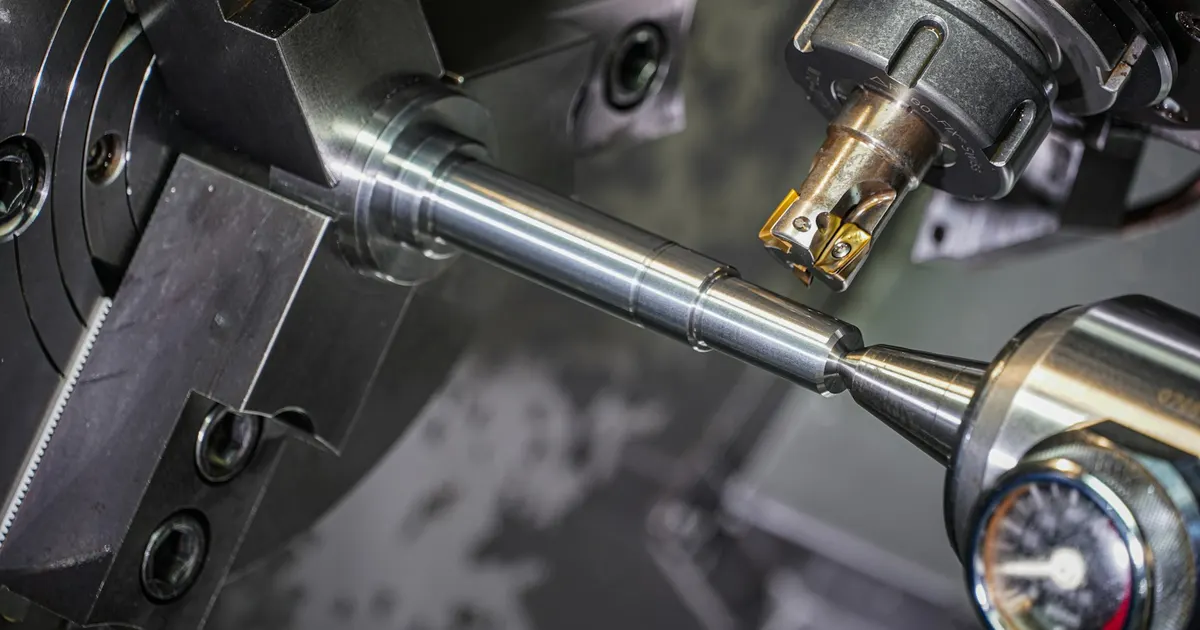
A Swiss-type lathe is one of the most common machines behind small implants and instrument shafts, and it is also one of the most over-recommended. This guide covers what the machine does differently, which medical part shapes it suits and which it does not, and what to check in a quote before the first lot.
What a Swiss-type lathe does differently
On a conventional lathe the bar is held in a chuck and the tool moves toward it. The longer the part sticks out of the chuck, the more it flexes under the cut. On a Swiss-type machine the bar is fed through a guide bushing, and the headstock slides the bar forward so the tool always cuts a few millimetres from the support. The part stays rigid at the point of the cut, however long it is.
Three other features matter for medical work. Live tooling lets the machine mill flats, cross holes and slots without moving the part to a second machine. A sub-spindle takes the part over at the cut-off and finishes the back end. A bar feeder keeps the machine running unattended, which spreads the set-up time over the lot.
Part shapes that fit
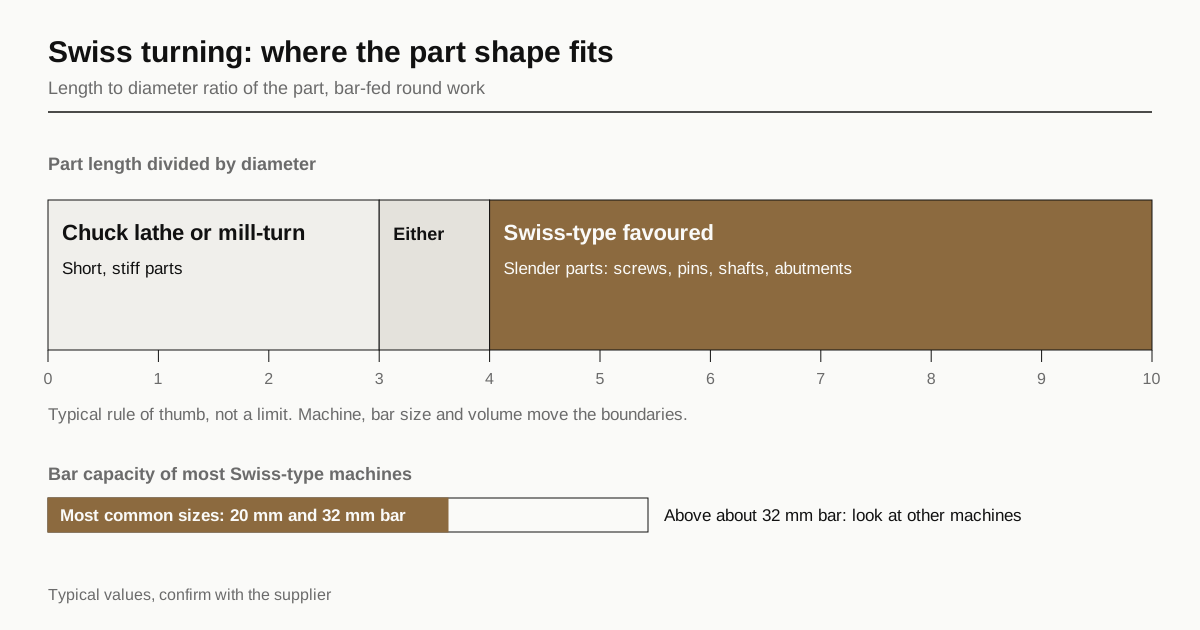
The simplest test is length against diameter. Once a part is more than about three to four times as long as it is wide, a chuck lathe starts to lose rigidity and a Swiss machine starts to earn its set-up cost. These part families usually land there:
- Bone screws and pins, including cannulated screws.
- Dental implant bodies and abutments.
- Instrument shafts, probes and guide wire holders.
- Trocar and endoscope components with long thin sections.
- Small connectors and fasteners made in volume.
Part shapes that do not fit
A Swiss machine has limits that are mechanical, not a matter of skill.
- Large diameter. Most machines cap out between 20 mm and 32 mm bar, with a few larger. A 50 mm femoral stem blank does not go through the guide bushing.
- Prismatic or flat parts. A plate with pockets belongs on a milling machine.
- Heavy milling. Live tools are small and light. Deep cavities and large flat faces are slow.
- Short parts at low volume. The set-up can take longer than the cutting.
| Part feature | Swiss-type fit | Better alternative |
|---|---|---|
| Round, length over 4 times diameter | Strong | None needed |
| Cannulation, cross holes, flats | Good | Mill-turn if bar is large |
| Diameter over 32 mm | Poor | Chuck lathe or mill-turn |
| Short, flat or pocketed | Poor | Vertical machining centre |
| Volume under a few hundred pieces | Depends on set-up | Chuck lathe |
Treat every figure in this table as typical. Machines differ, and a shop that runs a part family weekly will beat the table.
Bar stock decides more than people expect
The guide bushing leaves clearance of a few hundredths of a millimetre or less, so the bar has to be straight and consistent in diameter. Shops running titanium and stainless implant parts usually buy ground or precision drawn bar for that reason. Rolled or peeled bar may jam or leave a taper.
For implant parts, the bar also carries the material evidence. A part made from Ti-6Al-4V ELI to ASTM F136 needs a certificate that ties the bar to a heat lot and names that standard, and the shop needs to keep that link through every operation. Our guide to titanium, 316L and PEEK for medical parts covers how the standard changes both price and the supplier pool.
PEEK and other polymers can run on a Swiss machine, but they need a different guide bushing setup and a cooler cut, because heat and clamping stress change the part after it leaves the machine.
Tolerance and finish on Swiss work
Routine diameter tolerances on a stable Swiss process are often in the range of plus or minus 0.01 mm. Tighter is possible with finishing passes, in-process gauging and a temperature-stable room, and each step costs time. The length direction is a different story: the part moves between the guide bushing and the cut-off, so length tolerances depend on the sub-spindle and the cut-off tool, and they are often looser than diameters. Read tolerances on machined medical parts before you tighten a callout for comfort.
Thread forms, drive recesses and cannulation are the three features that most often set the price of a bone screw. The bone screw article goes through each of them in detail.
What a Swiss quote should tell you
Ask for these items in writing, because they separate a shop that knows the part from one that is guessing.
- Machine and bar size. The model class and the bar diameter it will use.
- Set-up time and who pays for it. Many shops quote it as a one-off line.
- Tooling plan. Whether the quote assumes tools dedicated to your alloy.
- Cycle time and lot size. The quote should say which lot size the unit price assumes.
- Inspection plan. What is measured in process and what is measured at final.
- Deburr and clean steps. Swiss parts leave the machine with burrs at the cut-off and at cross holes, and a plan for those costs time.
What drives the price of Swiss work
Four things move a Swiss quote more than the machine hour rate does.
Set-up and programming. A new part family can take a day or more to program, load tools and prove out, and a cannulated or multi-thread screw takes longer than a plain pin. Spread over a lot of five thousand, that hour is a rounding error. Spread over fifty pieces, it is most of the price.
Tool life on the alloy. Titanium and cobalt chrome wear tools faster than 316L, and a Swiss machine carries a fixed number of tool stations. When a tool wears mid-lot the machine stops, a person changes the insert and the part dimension has to be re-proven. Shops that run implant alloys all week usually have a tool-change interval worked out. Shops that do not will quote conservatively or learn on your parts.
Finishing steps outside the machine. Burr removal, cleaning, passivation and marking are separate operations, and on a small part they can cost more than the cutting. Ask the shop to list them in the quote as lines.
Scrap allowance. A first lot of a new part usually carries a larger scrap allowance than the repeat lots. A shop that offers a flat price for lot one and lot ten is either very experienced or not pricing the risk.
Mistakes buyers make with Swiss quotes
- Comparing unit prices at different lot sizes. A price at one thousand pieces and a price at five thousand are different offers.
- Tightening every callout. A tolerance on a non-mating diameter costs the same time as one on a mating diameter. Spend it where the function needs it.
- Forgetting the back end. The cut-off face, the sub-spindle grip and any back-working are part of the drawing. If the cut-off face matters, say so.
- Leaving the bar condition open. Writing only the alloy invites a shop to quote the cheapest bar that fits the guide bushing.
Before you choose Swiss
Run this short checklist against your drawing before you ask for quotes.
- Is the part round, made from bar under about 32 mm?
- Is the length more than three or four times the diameter?
- Does it need cross holes, flats or a back-end operation?
- Is the volume high enough to spread the set-up?
- Does the drawing name the material standard and the bar condition?
If the answer to the first two is no, ask quoting shops to price a second route as well. We match buyers with machining suppliers and charge the buyer nothing. We are not a machine shop and we do not qualify a supplier for you, because that belongs in your own quality system. To send a drawing, request a quote and we reply within 24 business hours.
Sources
- ASTM F136, wrought Ti-6Al-4V ELI alloy for surgical implant applications
- ASME Y14.5, dimensioning and tolerancing
Standards and regulations change. Check the current text at the source before you rely on it in a submission.
Frequently asked questions
Is a Swiss-type lathe always the right choice for small medical parts?
No. It is the right choice for long, slender, round parts made from bar. A small part that is short, flat or mostly milled can cost less on a mill-turn or a vertical machining centre, because a Swiss set-up spends hours on programming and tooling that a short part does not need.
What bar stock does a Swiss shop need for titanium or stainless medical parts?
Most Swiss work runs on ground or precision drawn bar with a tight diameter tolerance, because the guide bushing leaves very little clearance. Ask the shop what bar tolerance it assumed in the quote and whether the certificate for that bar names the standard on your drawing.
Does Swiss turning improve the surface finish or the tolerance by itself?
It improves the odds on slender parts, because the cut happens close to the support and the part deflects less. It does not replace good tooling, stable temperature or a sensible tolerance. A tolerance that is tight for the function will cost money on any machine.
Need a quote for this part?
Send the drawing. We match you with up to 3 medical machining suppliers and reply within 24 business hours.
Get matched with a medical machining supplier