Guides / Materials
Nitinol Machining: What Shops Can and Cannot Do
October 21, 2026
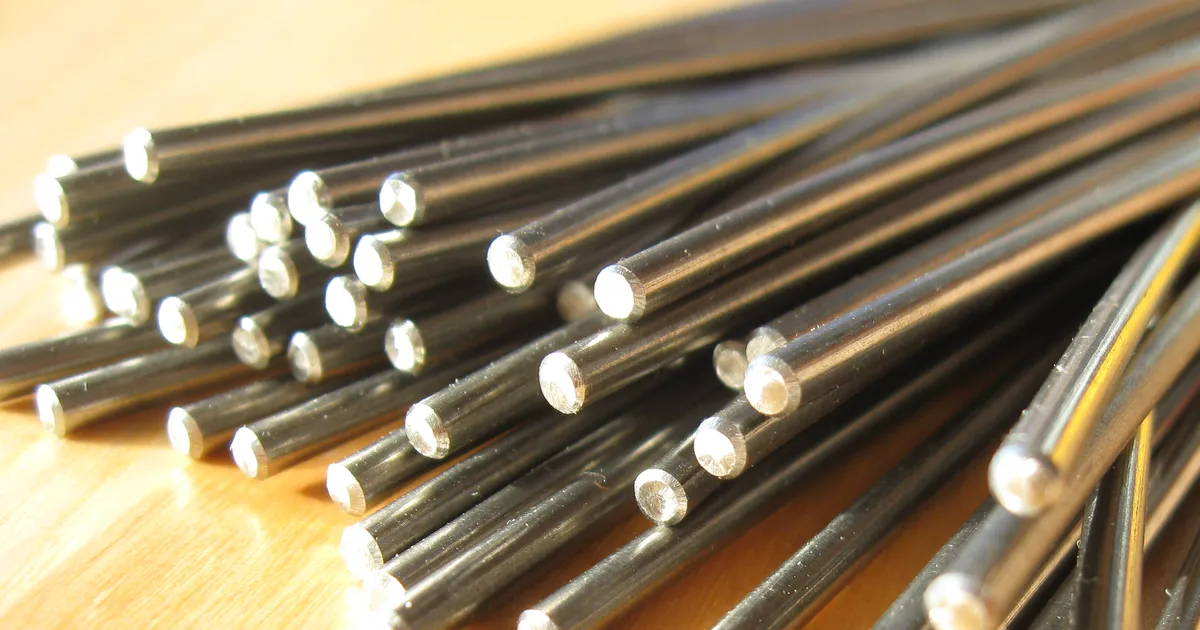
Nitinol is the nickel-titanium alloy behind self-expanding stents, guidewires, orthodontic wire and a growing list of surgical tools. It springs back from strains that would permanently bend stainless steel. That same behaviour makes it awkward to machine. This guide covers what a medical machining shop can reasonably do with nitinol, what lies outside plain machining and what to read before you send a drawing.
What makes nitinol different
Nitinol is roughly half nickel and half titanium by atom count. The wrought grade for medical use is covered by ASTM F2063, which sets chemistry limits, including a narrow nickel band, along with impurity limits and mechanical testing. Three properties matter at the machine.
- Superelasticity. At body temperature a nitinol part can recover large strains without taking a permanent set. A thin section springs away from the cutter.
- Shape memory. Below its transformation temperature the alloy deforms easily and returns to a remembered shape on warming.
- Heat sensitivity. Heat changes the transformation temperature. A part that gets hot in a cut or an oven can behave differently from the bar it came from.
The alloy is also tough, work hardens quickly and conducts heat poorly. A dull tool rubs, heats the surface and leaves a hardened skin that fights the next pass.
Stock forms and why they matter
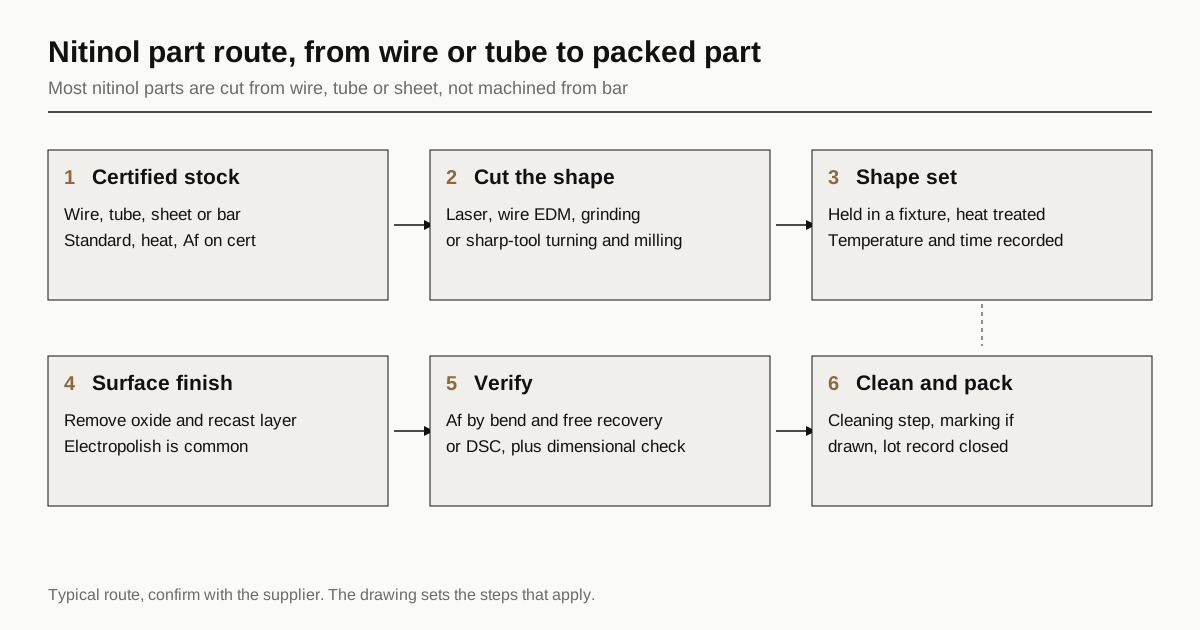
Most nitinol parts do not start as bar. They start as wire, tube, sheet or a thin strip, because the device design already assumes a thin or slender shape. Bar and rod exist and suit small machined parts such as fittings, couplings and tool components, but supply is narrower and lead times are longer than for titanium bar.
| Stock form | Typical use | Common cutting method |
|---|---|---|
| Wire | Guidewires, baskets, orthodontic arch wire, frames | Centreless grinding, cutting, forming |
| Tube | Stents, cannula, catheter parts | Laser cutting, then finishing |
| Sheet or strip | Clips, flat springs, thin frames | Laser, wire EDM, etching, stamping |
| Bar or rod | Small fittings, couplings, tool parts | Turning, milling, drilling |
Ask the shop which of these forms your drawing assumes. A drawing for a laser-cut tube pattern sent to a general machine shop will waste both sides’ time.
What a machine shop can do
A shop with good tooling and patience can machine nitinol bar into small parts. The methods that work follow the same logic as other gummy, work hardening alloys.
- Sharp carbide tools with positive rake. Rubbing is the enemy. Fresh edges cut cleaner than worn ones.
- Steady feed. A dwell or a light pass work hardens the surface. Commit to the cut.
- Plenty of coolant. Flood cooling keeps heat out of the cut and out of the part.
- Small, deliberate step-downs. Thin features need support because the material springs away from the tool.
- Planned burr control. Burrs on nitinol are tough and stringy. Deburring is a process step, not a tidy-up, and our guide to deburring medical parts covers acceptance.
Wire EDM is widely used for profiles in sheet and plate, because it cuts without force and without any tool wear issues. The recast layer questions we describe in our article on wire EDM for surgical instrument jaws apply here as well, and for nitinol the surface oxide and nickel release are part of the same conversation.
What lies outside plain machining
The cut is only part of a nitinol part. Several steps decide whether it works, and a general machine shop may not offer them.
- Shape setting. The part is held in a fixture and heat treated so it remembers the shape. The temperature and time are recorded, because they change the transformation temperature.
- Surface finishing. Heat treatment and cutting leave an oxide layer and, for EDM and laser, a recast layer. Electropolishing is a common finish that removes both and leaves a smooth, clean oxide.
- Transformation temperature test. A bend and free recovery test, described in ASTM F2082, or a differential scanning calorimetry run confirms the temperature.
- Fatigue and corrosion work. These tests belong to the device maker and its risk file.
A buyer who sends a drawing for a nitinol part should ask who owns each step. If the machine shop sends parts to a heat treater or a polishing vendor, the quality agreement should say so. Our guide to the quality agreement with a machine shop covers the clauses.
What shops cannot promise
Some requests sound like machining and are not. A fair shop will say so before the quote.
- A transformation temperature it cannot test. If the shop has no way to measure Af, it cannot promise a value.
- A tight tolerance on a shape set part at room temperature. The part moves during heat treatment and again when it warms or cools.
- A finished surface with no finishing step. A machined or EDM surface is not an electropolished surface.
- A lot that mixes heats. Transformation temperature varies by heat, so a lot made of two heats can behave as two populations.
None of these is a failure. They are limits of the process, and a drawing that respects them quotes faster and costs less.
Nickel release and the biocompatibility file
Nitinol carries nickel, and the surface condition decides how much leaves the part in service. A well-prepared surface with a thin, stable titanium oxide releases very little. A rough or heat tinted surface can release more. The FDA publishes technical considerations for nitinol devices that cover corrosion, nickel release and fatigue, and a supplier should know where the buyer’s surface requirement comes from. The testing and the claim remain with the device company. A machine shop supplies the surface condition the drawing asks for.
Cost drivers
Nitinol parts cost more than similar titanium parts. The drivers are plain.
| Driver | Why it adds cost |
|---|---|
| Stock price | Medical nitinol is made in small melts with tight chemistry control |
| Tool wear | Sharp tools are changed early and cut slowly |
| Heat treatment | Fixtures, furnace time and recorded cycles |
| Finishing | Electropolish and cleaning, often at an outside vendor |
| Testing | Transformation temperature and dimensional checks after shape setting |
| Scrap | A part that misses its shape or temperature cannot be reworked easily |
Typical values, confirm with the supplier. A first article with a small lot costs more per part than a repeat order, because the shape setting fixture and the temperature check are spread over fewer pieces.
Certificates and traceability
Read the nitinol certificate for the standard and revision, the heat number, the chemistry, the transformation temperature if the drawing asks for it and the condition of the material. Cold worked wire and annealed bar behave differently. Our guide to medical bar stock certificates walks through the fields on a certificate in the same order a receiving inspector reads them.
What to put on the drawing
A drawing that works for nitinol states several things plainly.
- The standard and the form of stock.
- The required transformation temperature and how it is measured.
- The shape setting steps, or a note that the shop is to propose them.
- The surface finish and whether electropolish is required.
- Which dimensions are measured before shape setting and which after.
- Cleaning and marking requirements.
Next step
Before you request quotes, decide which of those six items your drawing already answers. Send the drawing with the open items marked, and ask each shop to say which steps it performs in house and which it sends out.
We match buyers with machining suppliers and the buyer pays us nothing. We do not machine nitinol, and the qualification of a supplier stays in your own quality system. To send a drawing, request a quote and we reply within 24 business hours.
Sources
- ASTM F2063, wrought nickel-titanium shape memory alloys for medical devices and surgical implants
- FDA, technical considerations for non-clinical assessment of medical devices containing nitinol
Standards and regulations change. Check the current text at the source before you rely on it in a submission.
Frequently asked questions
Can a normal CNC shop machine nitinol?
A shop that cuts titanium and stainless steel can turn and mill nitinol with the right tooling, but the results depend on experience. The alloy is gummy, work hardens and burrs badly. The harder questions come after cutting: shape setting, surface condition and transformation temperature, which are heat treatment topics rather than machining ones.
Why is most nitinol cut by laser or wire EDM instead of milled?
Most nitinol devices start as thin wire, tube or sheet. Laser cutting suits tube for stent-like patterns and wire EDM suits fine profiles in sheet or plate. Both avoid cutter forces on a springy, work hardening material. Each leaves a heat affected surface that a later step has to clean up.
What is the transformation temperature on a nitinol certificate?
It is the temperature range over which the alloy changes between its two crystal structures. Suppliers often quote the austenite finish temperature, Af. It decides whether a part acts as a spring at body temperature or holds a set shape, so it belongs on the drawing as a requirement and not as a surprise on the certificate.
Need a quote for this part?
Send the drawing. We match you with up to 3 medical machining suppliers and reply within 24 business hours.
Get matched with a medical machining supplier