Home / Standards
Standards a medical machining supplier meets
A machining supplier meets medical standards through its customer: the device maker names them in the drawing, the purchase order and the quality agreement. This index sorts the standards by topic and says, for each, who owns it and what reaches the shop.
The standards by topic
| Topic | Main documents | Owner | What reaches the shop |
|---|---|---|---|
| Quality system | ISO 13485:2016; 21 CFR 820 (QMSR) in the US; EN ISO 13485 in the EU | Device maker | Purchasing controls, change notification, traceability, records |
| Risk management | ISO 14971 | Device maker | Process risk inputs, PFMEA, notice of changes |
| Biocompatibility | ISO 10993-1 (2025 edition) and the other parts of ISO 10993 | Device maker | Allowed process fluids, residue limits, cleaning records |
| Cleaning and cleanliness | Device maker's validated method; ISO 19227 for orthopedic implants | Device maker, shop runs it | Validated cleaning, records per lot |
| Passivation | ASTM A967, ASTM F86 | Shop or sub-tier, to the drawing | Method, test, validation records. See ASTM F86 |
| Marking and UDI | 21 CFR 801 subpart B; EU MDR Article 27; ISO/IEC AIDC standards | Device maker | Mark content, position, durability after reprocessing |
| Sterilization | ISO 11137 (radiation), ISO 11135 (ethylene oxide), ISO 17665 (moist heat) | Device maker and its sterilizer | Material and residue compatibility, packaging inputs |
| Mechanical testing | ASTM F543, F382, F1717, F1264, F2077; ISO 14801 | Device maker or test lab | A frozen, validated process for the tested parts |
| Supplier audits by notified bodies | EU MDR Annex IX sections 2.3, 3.3 and 3.4; Team-NB code of conduct | Device maker, with its notified body | Lot records, access clause in the quality agreement. See notified body audits of subcontractors |
| CMR substances in alloys | EU MDR Annex I section 10.4; CLP classification | Device maker | Alloy callout, certificate chemistry, change notice, residue control. See CMR substances in cobalt and nickel alloys |
| Instrument corrosion | ISO 13402; ASTM F1089 | Device maker, shop runs the process | Passivation record, test report. See ISO 13402 and F1089 |
| General requirements for implants | ISO 14630:2024 (level 1 of the implant standards) | Device maker | Material callout, cleanliness, records. See ISO 14630 |
| General requirements for implant instruments | ISO 16061:2021; ISO 7153-1:2016 for metals | Device maker | Material, passivation, corrosion test, marking. See ISO 16061 |
| Certificates a supplier can show | ISO 13485 certificate; EU MDR certificate (notified body) | Certification body or notified body | Original certificate, scope and site. See CE certificate or ISO 13485 certificate |
| Laboratories | ISO/IEC 17025:2017; GLP (21 CFR 58); FDA ASCA | Device maker chooses the laboratory | Scope line for the method. See verifying a laboratory |
| Audit preparation for a subcontractor | Team-NB code of conduct, section 7; MDR Annex IX | Notified body, with the device maker | Lot trace, contract clause. See notified body audit preparation |
| Canadian market | Health Canada MDSAP rule for class II to IV devices | Device maker | Supplier controls, possible audit. See Health Canada and MDSAP |
| Cobalt-chromium alloys | ASTM F75, F799, F1537, F90 | Device maker | Specification, alloy and condition on the drawing. See CoCr alloys compared |
| Metals for standard instruments | ISO 7153-1:2016; ASTM F899 | Device maker | Grade, condition and hardness on the drawing. See ISO 7153-1 |
| Implant surface preparation and marking | ASTM F86 | Device maker, shop runs the process | Treatment, marking and post-mark records. See ASTM F86 |
| Implant surface finish | ISO 7206-2 (hip), ISO 7207-2 (knee), ISO 21920 for parameters | Device maker | Parameter, cutoff, location and part state on the drawing. See surface finish requirements |
| Restricted substances in electrical devices | Directive 2011/65/EU (RoHS) | Device maker | Material declaration, lead exemption, finish chemistry. See RoHS and medical device parts |
| PFAS and fluoropolymers | EU universal PFAS restriction proposal under REACH (not in force) | Device maker | Material list per part, supplier declarations. See PFAS and fluoropolymer parts |
| Process validation | ISO 13485 clause 7.5.6; GHTF SG3/N99-10 guidance | Device maker, with the shop | IQ, OQ and PQ for processes that cannot be fully verified |
Editions change. Check the current edition of each document at its source before you cite it in a procedure.
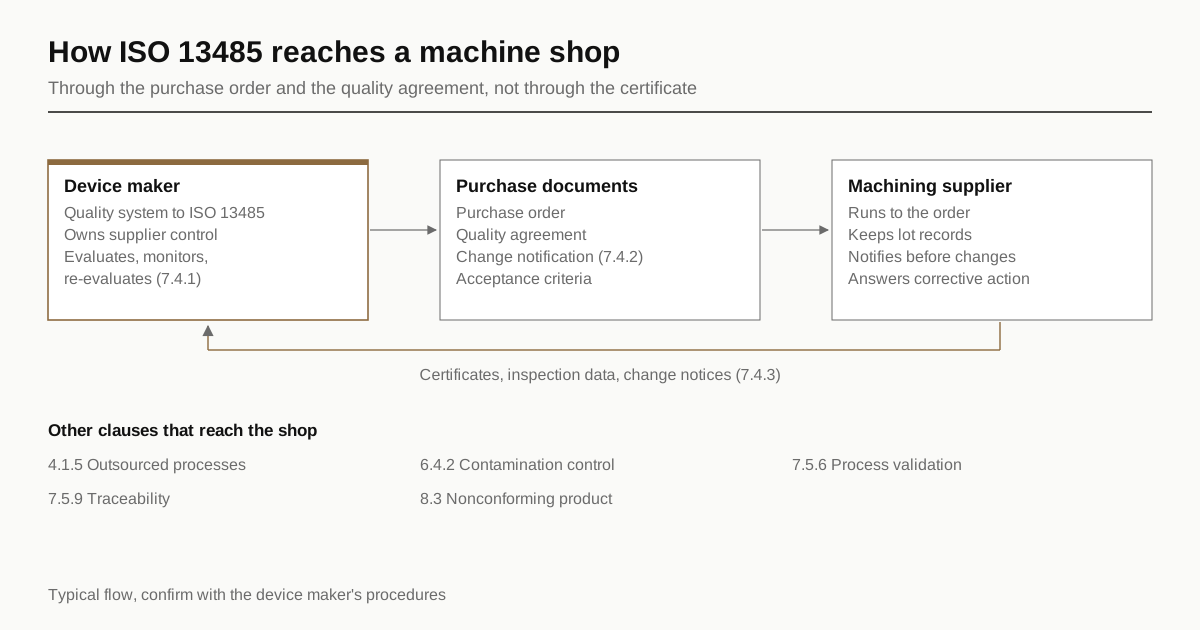
Who owns the standard
Almost every standard on this list is owned by the device maker. The shop meets the parts that the device maker writes into the purchase order and the quality agreement. That has two consequences.
- Qualification stays with the device maker. A shop cannot be "compliant" with ISO 14971 or ISO 10993 on its own. It can supply the inputs those standards need. A shop that claims more is either confused or selling.
- The order has to say it. A shop cannot guess which cleaning method, passivation test or mark content applies. If it is not in the order or the agreement, it is not in the shop's scope.
The test methods behind these standards, such as grain size, inclusion rating and alpha case, have their own test methods index.
The guides go into the shop side of several topics: ISO 10993 and machining residue, passivation validation, UDI laser marking and IQ, OQ and PQ. The processes overview shows where each step sits in a part's route.
How the detail pages relate
Each detail page takes one standard or regulation, sets out the clauses that reach a supplier and says what a shop should be ready to show. The quality system pages come first, because every other standard is applied through them. Material specifications have their own index.
Information, not regulatory advice. Confirm requirements with your quality and regulatory teams.
Last reviewed 18 October 2026
Need a quote for this part?
Send the drawing. We match you with up to 3 medical machining suppliers and reply within 24 business hours.
Get matched with a medical machining supplier