Home / Material specifications
Implant and instrument material specifications
Implant drawings name a material specification, not a trade name. This index lists the ASTM F and ISO 5832 documents that appear most often on machined medical parts, with the alloy, the product form and the device families that use them.
The main specifications
| Specification | Material | Product form | ISO counterpart | Typical device use |
|---|---|---|---|---|
| ASTM F136 | Ti-6Al-4V ELI | Wrought bar, wire, sheet, strip, plate | ISO 5832-3 (without ELI limits) | Screws, plates, nails, stems, dental parts |
| ASTM F1472 | Ti-6Al-4V, standard interstitials | Wrought | ISO 5832-3 | Implant parts where the file accepts standard grade |
| ASTM F67 | Unalloyed titanium, grades 1 to 4 | Bar, wire, sheet, strip, plate | ISO 5832-2 | Dental fixtures, plates, small parts |
| ASTM F1295 | Ti-6Al-7Nb | Wrought | ISO 5832-11 | Stems, nails and plates in some systems |
| ASTM F3001 | Ti-6Al-4V ELI, additive manufacturing | Powder bed fusion parts | None directly | Printed cages, acetabular shells, then machined |
| ASTM F138 | 316LVM stainless steel | Bar and wire | ISO 5832-1 | Trauma plates, screws, pins, wires |
| ASTM F899 | Stainless steels for surgical instruments | Bar, sheet, forgings | ISO 7153-1 | Instruments: jaws, shafts, reamers, drills |
| ASTM F1537 | Wrought CoCrMo, alloys 1 to 3 | Bar, rod, wire | ISO 5832-12 | Femoral heads, tapers, rods |
| ASTM F75 | Cast CoCrMo | Castings | ISO 5832-4 | Knee femoral components, cast shells |
| ASTM F562 | MP35N (CoNiCrMo) | Bar, wire | ISO 5832-6 | Leads, springs, small cardiovascular parts |
| ASTM F2063 | Nitinol (NiTi) | Bar, wire, tube | None directly | Staples, stents, guide components |
| ASTM F560 | Unalloyed tantalum | Bar, wire, sheet | None directly | Radiographic markers, porous structures |
| ASTM F648 | UHMWPE | Resin and fabricated forms | ISO 5834 series | Liners, tibial inserts |
| ASTM F2026 | PEEK | Resin and stock shapes | None directly | Interbody cages, some instruments |
Typical pairings. ISO counterparts cover the same alloy family but are not identical in every limit or test. The device maker's file decides which documents are acceptable.
How to read the index
Three points apply to every row.
- The specification is dated. ASTM and ISO documents are revised. A drawing either names an edition or the device maker controls the edition through its own document review.
- Dual certification is common. Many mills certify one heat to an ASTM document and its ISO counterpart. Whether a single certificate to either is acceptable is a device file decision, not a shop decision.
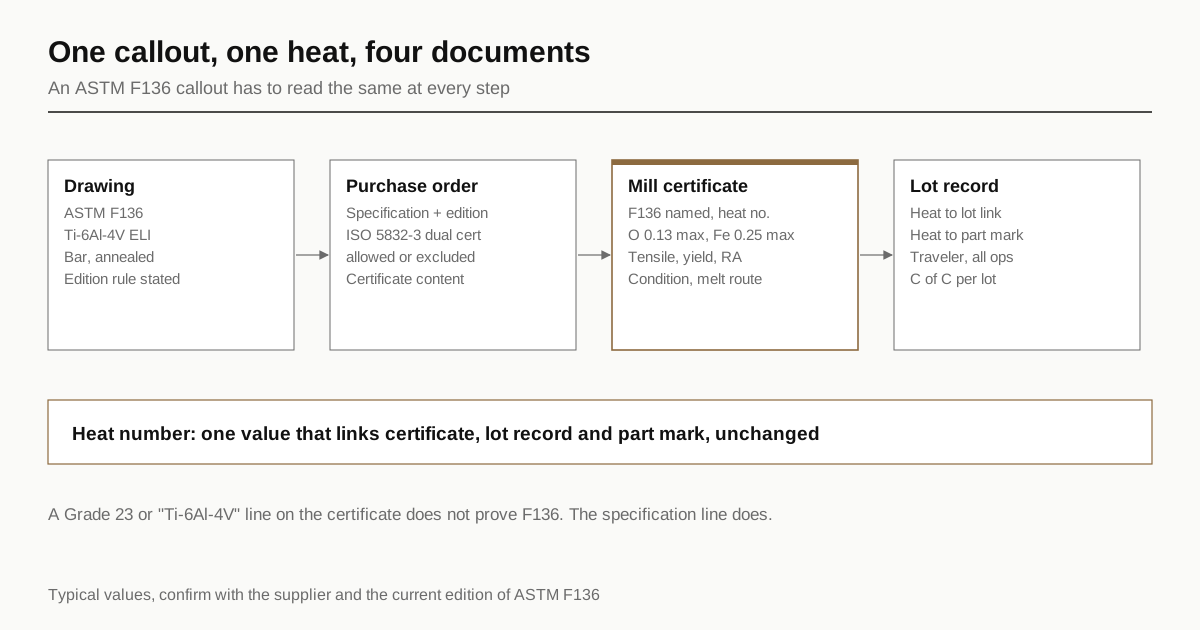
- The certificate must name the specification. An industrial grade name, a UNS number alone or "medical grade" does not prove the implant specification was met. The bar stock certificate guide covers what to read.
ISO 5832 and the ASTM documents
The ISO counterparts in the table come from the ISO 5832 series. The ISO 5832 page lists the parts one by one beside the ASTM F documents and shows where the two differ. The cobalt-chromium family has its own comparison of F75, F799, F1537 and F90. The tests that back the specifications, such as grain size and alpha case, are in the test methods index.
How the detail pages relate
Each detail page takes one specification and covers what the device maker writes on the drawing, what the certificate must show and the records the shop keeps. Material comparisons and machining notes stay in the guides, for example titanium, 316L and PEEK and cobalt chrome machining. The materials overview sorts the same alloys by how they machine. The device families map shows which family uses which specification.
Choice of material belongs to the device design and its test evidence. A shop should never be asked to substitute one specification for another.
Last reviewed 18 October 2026
Need a quote for this part?
Send the drawing. We match you with up to 3 medical machining suppliers and reply within 24 business hours.
Get matched with a medical machining supplier