Guides / Materials
17-4 PH and 420 Stainless for Surgical Instruments: Heat Treat, Machining and Finish
October 4, 2026
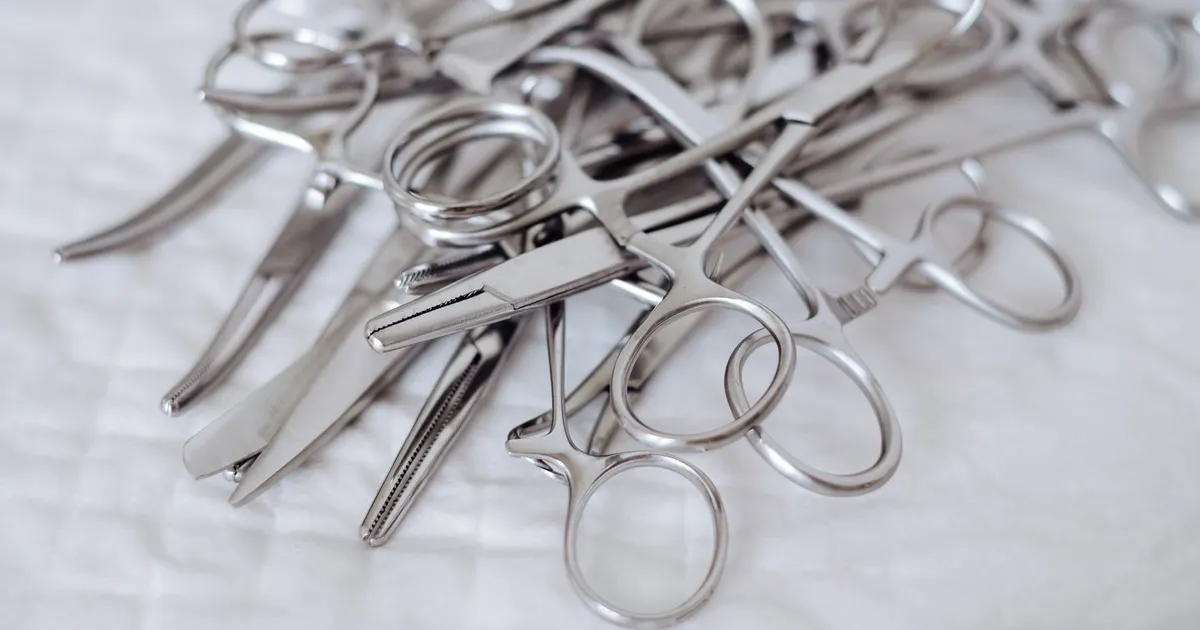
Two stainless steels sit behind a large share of reusable surgical instruments: 17-4 PH for parts that need strength and corrosion resistance, and 420 for parts that need a hard edge. They look alike on a drawing and behave very differently in heat treatment, machining and service. This guide explains the differences and what to write so a quote prices the right route.
What each steel is
17-4 PH is a precipitation-hardening martensitic stainless steel with chromium, nickel and copper. The name comes from roughly seventeen percent chromium and four percent nickel. It is machined in a soft solution-annealed condition and then aged at a moderate temperature to reach its strength. Different aging temperatures give different conditions, commonly named H900, H1025, H1075 and H1150, with the number as the temperature in degrees Fahrenheit.
420 is a martensitic stainless steel with about twelve to fourteen percent chromium and a higher carbon content, which lets it harden by quenching and tempering. It can reach high hardness, which is why it appears in cutting edges and instrument tips. It has lower corrosion resistance than 17-4 PH and much lower than 316L.
ASTM F899 covers the chemistry of wrought stainless steels for surgical instruments, with martensitic and precipitation-hardening classes among them. Mechanical properties, heat treatment and hardness come from the material standards it points to or from the agreement between buyer and supplier, so the drawing has to carry them.
Side by side
| Factor | 17-4 PH | 420 |
|---|---|---|
| Hardening route | Age at low temperature | Quench and temper |
| Typical use | Handles, shafts, structural parts, some jaws | Blades, tips, cutting edges |
| Hardness range, typical | About 28 to 44 HRC by condition | Often about 48 to 56 HRC |
| Distortion in hardening | Small and fairly predictable | Larger, needs finishing allowance |
| Corrosion resistance | Better of the two | Lower, needs good surface |
| Edge holding | Moderate | Good |
| Magnetic | Yes | Yes |
Hardness figures are typical and depend on condition and tempering. Always read the figure from the drawing or the heat-treat certificate and not from a table like this.
The machining route for 17-4 PH
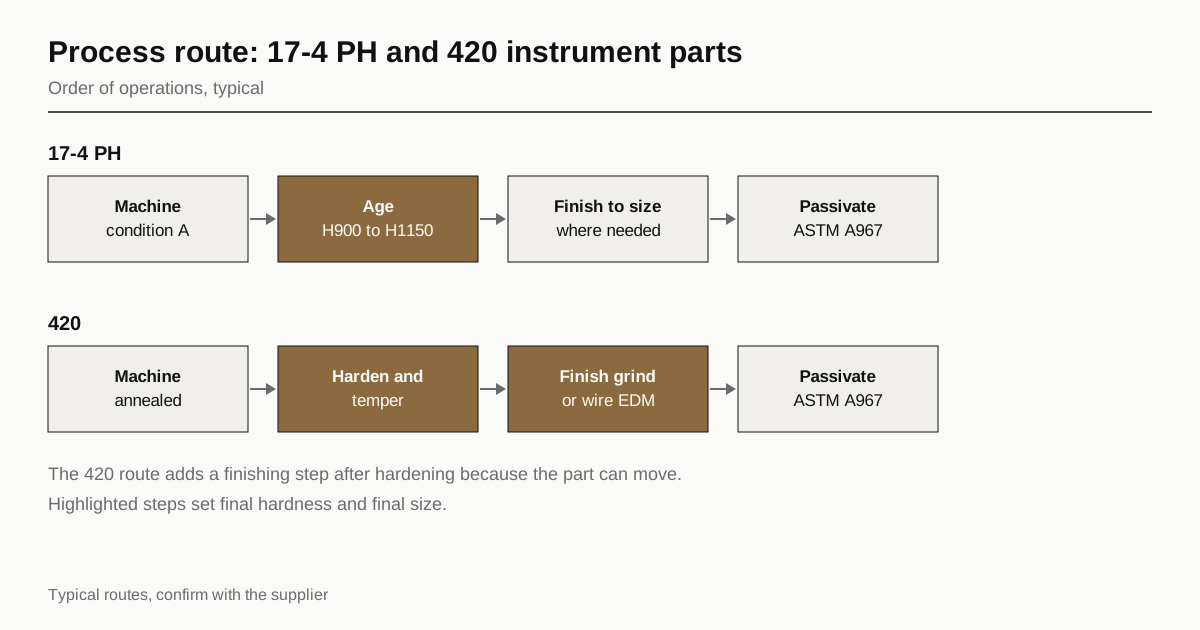
The shop machines the part in condition A, where the steel is soft enough to cut well. It then ages the part to the required condition, for example H900 for the highest strength or H1025 for a better balance of strength and toughness. Aging makes a small and fairly predictable dimensional change, on the order of a few hundredths of a percent, so shops either compensate from past data or leave stock on critical features and finish after aging.
Condition A 17-4 PH is somewhat gummy, and chips can be stringy. Sharp tools and good coolant help. The finished surface is passivated and, for instruments, often electropolished or bead blasted depending on the finish the design calls for.
The machining route for 420
The route is longer. A shop machines the part in the annealed condition, sends it for hardening and tempering, then finishes it to final size, usually by grinding. Hardening can move the part, so the shop leaves stock for the finish pass.
Hardening quality has three levers. A vacuum or controlled-atmosphere furnace avoids a decarburised, soft skin on the part. A deep cold step after quenching converts retained austenite to martensite and stabilises size. Tempering sets the final hardness and toughness. A heat-treat certificate should list the process, the achieved hardness and the lot, and it should travel with the parts. Because hardening is often done by an outside vendor, the machining shop’s control of that vendor matters. See how to qualify an ISO 13485 supplier for what to check on sub-tier processes.
Fine features after heat treat
Teeth, jaws and cutting profiles on hardened instrument steel are hard to mill. Wire EDM cuts hardened steel without cutter force and is a standard route for those features. Our guide to wire EDM for surgical instrument jaws covers what it leaves on the surface and how that is finished.
Corrosion, passivation and steam sterilization
Reusable instruments go through washing, thermal disinfection and steam sterilization again and again over their life, and device manufacturers have to give reprocessing instructions. Neither of these steels matches 316L for corrosion resistance, so surface condition counts for a great deal.
Three habits reduce problems. Passivation, commonly to ASTM A967, removes free iron from the surface and builds a stable oxide. Clean surfaces passivate evenly, so cleaning comes first. Surface finish that is smooth and free of pits, crevices and embedded particles resists staining better than a rough one. Our guide to passivation and electropolish covers the process choices, and cleaning validation covers the residue side.
A 420 part that is hardened and left unpassivated can stain quickly. A 17-4 PH part aged but not passivated is better off, but not immune.
What goes on the drawing
Five lines remove most quote ambiguity.
- Grade and standard. 17-4 PH or 420, with the specification the bar must meet, for example ASTM F899 or the bar standard your design uses.
- Condition or hardness. H900, H1025 or a hardness range for 420, with the test method.
- Heat-treat requirements. Furnace type, deep cold step if needed and certificate content.
- Surface treatment. Passivation standard, electropolish or blast and the finish value.
- Distortion allowance. Whether the shop finishes after hardening and what dimensions control.
How to write a medical machining RFQ lists the rest of what a shop needs to quote cleanly.
Which steel for which part
A single instrument often uses both steels, and the split follows what each part has to do.
- Cutting blades, scissor edges and tips. Edge holding favours 420 hardened and tempered.
- Handles, shafts and ratchets. Strength, toughness and corrosion resistance favour 17-4 PH, usually at a higher aging temperature when toughness matters.
- Box-lock hinges and screws. Wear and galling decide, and the design team often specifies a different grade or a surface treatment for the pair.
- Disposable or single-use parts. The reuse question disappears, and cheaper grades may fit. That is a design call.
Design teams choose these. A shop that suggests a swap to save money is going beyond its role, and the suggestion would need a design review and a new set of evidence in your file.
Cost and lead time
The 17-4 PH route is shorter. One heat treat step at a modest temperature, and parts can be finished close to size. The 420 route has an extra finishing step after hardening, usually grinding, and often a vendor handoff each way. That adds days and a second place for parts to wait.
Three lines on a quote tell you what the route costs. Heat treat, either in-house or outside. Finish grinding or EDM on 420 parts. Passivation and any surface finish. Ask for each as a line and not a lump. Our guide to what drives the cost of a machined medical component explains how those lines usually behave across a quote.
Lead time depends on the furnace queue as much as on the machine. A shop that sends parts to a vendor every Tuesday has a different lead time from one that heat treats in-house, and neither is wrong. What matters is that the number on the quote includes the wait.
Mistakes that cost money
- Writing “17-4” without the condition. H900 and H1150 are different parts.
- Specifying tight dimensions before heat treat on 420. The part will move, and the shop will have to grind to recover.
- Ignoring the heat-treat vendor. A good machining shop with a poor hardening vendor ships a poor part.
- Using 420 where corrosion matters more than edge. A handle in 420 will stain where 17-4 PH would not.
What to ask a shop
- Which condition and hardness do you plan, and how do you verify them?
- Who hardens the parts, and how do you control that vendor?
- How much finishing stock do you leave on 420?
- How do you passivate, and to what standard?
- How do you keep the heat lot and the heat-treat lot linked to each part?
We match buyers with machining suppliers and the buyer pays us nothing. We do not machine or heat treat parts and we do not qualify a supplier for you, because that stays in your own quality system. To send a drawing, request a quote and we reply within 24 business hours.
See also: ISO 7153-1 and the four instrument steel groups, for how the 2016 standard sorts martensitic, ferritic, austenitic and precipitation hardening grades.
Sources
- ASTM F899, wrought stainless steels for surgical instruments
- ASTM A967, chemical passivation treatments for stainless steel parts
Standards and regulations change. Check the current text at the source before you rely on it in a submission.
Frequently asked questions
Which is better for surgical instruments, 17-4 PH or 420?
Neither is better in general. 420 hardens higher and holds a cutting edge, so it suits blades and tips. 17-4 PH hardens by a low-temperature aging step with less distortion and resists corrosion better, so it suits structural parts and handles. Many instruments use both in different components.
Why does heat treatment matter so much on instrument parts?
Because the final hardness, size and corrosion resistance all come from it. 420 is hardened by quenching and tempering, which can move the part. 17-4 PH is aged at a lower temperature, so it moves less. The route decides when finishing happens and how much stock the shop leaves.
Do both grades corrode in steam sterilization?
Both are less corrosion resistant than 316L and both can pit or stain in repeated cycles if the surface is poor or the cleaning chemistry is harsh. Passivation, good surface finish and correct reprocessing instructions from the device manufacturer reduce the risk.
Need a quote for this part?
Send the drawing. We match you with up to 3 medical machining suppliers and reply within 24 business hours.
Get matched with a medical machining supplier