Guides / Technical
Diagnostic and Lab Instrument Parts: Lower-Risk Medical Work
October 15, 2026
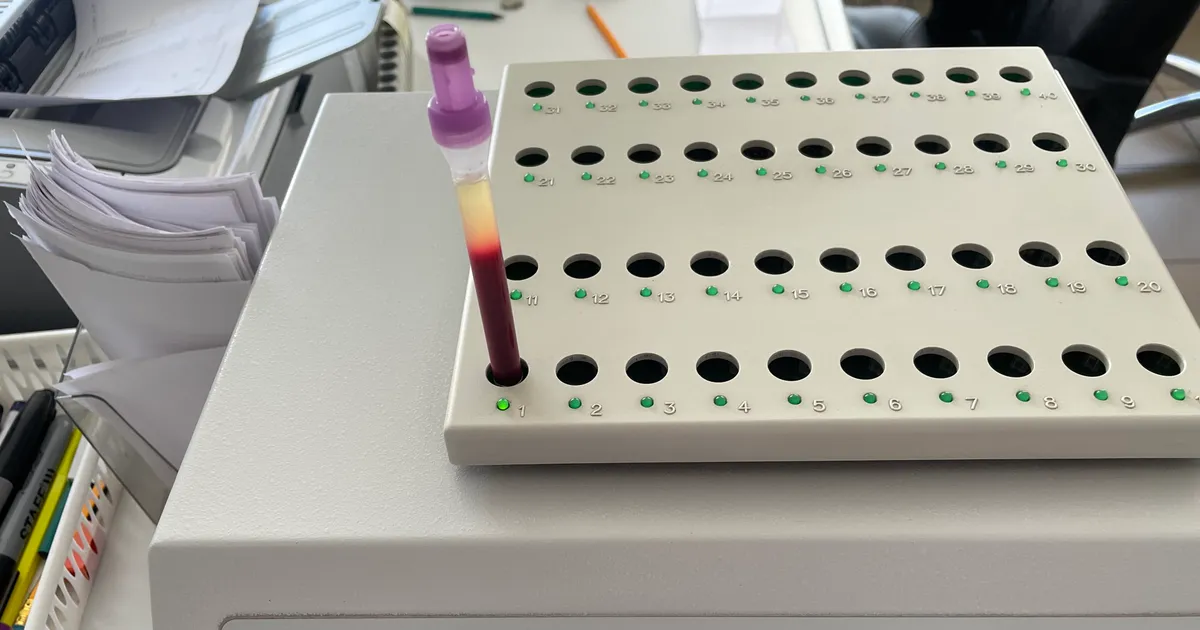
Diagnostic and laboratory instruments are a large, quiet market for machined parts. Blood analysers, sequencers, immunoassay systems and centrifuges all contain precision aluminium, stainless steel and plastic components. The parts rarely touch a patient. They sit inside a box that measures something. This guide covers what these parts are, what to watch at the machine and how documentation changes compared with implants and instruments.
Why this work is called lower risk
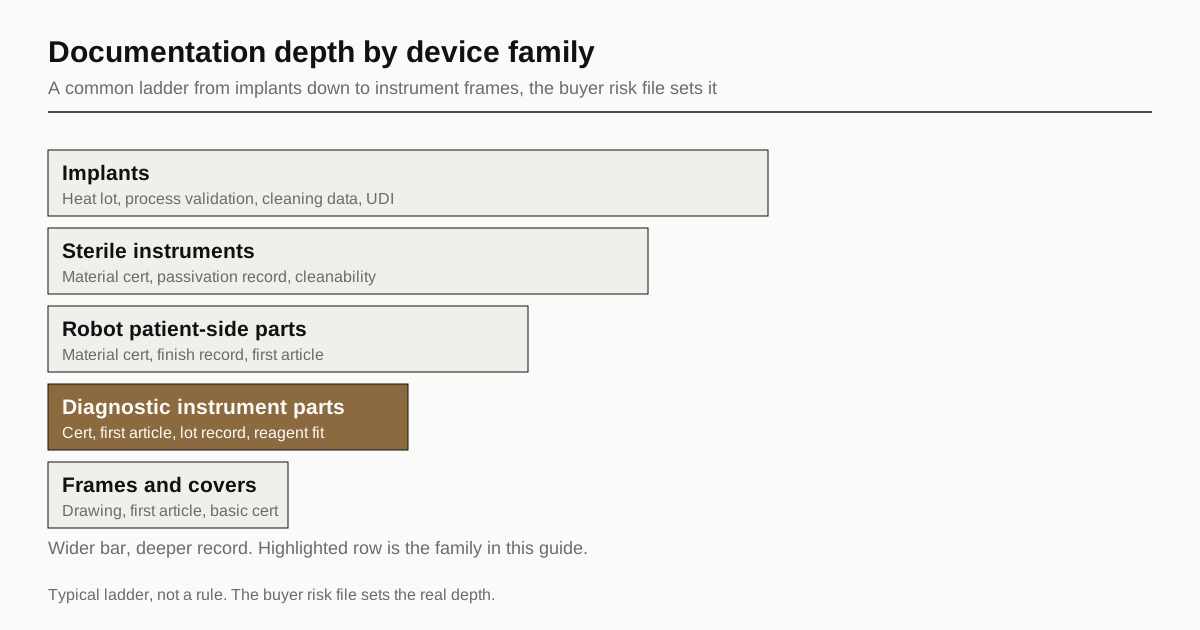
An implant stays in a body for years, and a failure harms the patient directly. An instrument frame sits in a laboratory. A failed part stops a test run or gives a wrong reading. Both matter, and the second is a smaller and less direct risk. Regulators treat in vitro diagnostic devices under their own rules, such as the FDA’s in vitro diagnostics framework and the European IVD Regulation. The device company classifies its product, and the quality system follows.
For the machine shop the practical result is simple: fewer process validations, no implant-grade materials in most cases and a lighter documentation load. The word to hold onto is “lighter”. It does not mean none. Our guide to medical component machining cost explains how that depth shows in price.
Typical parts
| Part | Typical material | What matters |
|---|---|---|
| Sample rack and tray | Plastic or aluminium | Position accuracy, wear, cleanability |
| Fluidic manifold | Acrylic, PEEK, stainless steel | Channel finish, no dead volume, burr-free cross holes |
| Pump or valve body | Stainless steel, PEEK, PTFE | Sealing face finish, chemical compatibility |
| Optical bench and mounts | Aluminium, sometimes invar or stainless steel | Flatness, stability, black anodize |
| Probe and needle holder | Stainless steel | Concentricity, straightness |
| Rotor or carrier | Aluminium or titanium | Balance, safety margin, marking |
| Enclosure and frame | Aluminium sheet and plate | Fit, finish, cosmetic standard |
| Motor and gear mounts | Aluminium or steel | Hole position, squareness |
Typical choices, confirm with the supplier. Many of these parts share their material families with other precision machines.
Fluid handling
Parts that carry samples and reagents have special needs. A fluidic manifold is a block with drilled channels, valve seats and ports. Several things go wrong easily.
- Burrs inside cross holes. A burr where two channels meet breaks off into the sample or catches air.
- Dead volume. A blind drilled hole beyond a junction holds liquid that carries over into the next sample.
- Rough channel walls. Roughness traps particles and bubbles.
- Chemical attack. Some plastics craze with solvents, and some metals corrode with salt-based buffers.
Shops control these by drilling in a planned order, using a borescope to look inside and flushing parts clean. A drawing should list the reagents the part meets so that the shop and the buyer can check compatibility. Our guide to medical plastics beyond PEEK covers plastic choices, and the same compatibility questions apply here.
Optics and surfaces
Optical benches and mounts hold lenses, filters and detectors. They need flat and stable surfaces and low reflectance. Black anodize on aluminium is the standard answer to stray light. The anodize thickness changes dimensions, so features that have to fit after anodize are machined with that allowance. Flatness over a large aluminium block moves with temperature and with stress relief, so shops often rough, stress relieve and finish. Our guide to tolerances on machined medical parts explains why a tight number needs a measurement plan.
Cleanliness
Particles matter in analysers. Shops handle parts that carry fluids or optics with clean gloves, wash them after machining and pack them in sealed bags. The depth of cleaning follows the buyer’s requirement. A drawing might call for an ultrasonic clean and a particle count, or only a wipe and a sealed bag. Our guide to cleaning validation for machined implants is written for a stricter case, but the thinking, define the residue and set a limit, carries over.
Rotors and safety parts
A centrifuge rotor spins at high speed with a sample load. The consequences of a failure are severe, so rotors carry stricter controls than most instrument parts: material certificate, balance, inspection of critical dimensions and often a marked life limit. The design and testing belong to the device company. A shop that machines rotors should say so up front and show how it controls the work.
Volume and the quote
Instrument parts range from a few prototypes to several thousand a year per part number. Prototypes dominate the early stages, followed by a ramp. Buyers can reduce cost by:
- Asking for quotes at prototype, pilot and production quantities
- Keeping tolerance on the features that need it
- Agreeing a finish standard with samples for cosmetic parts
- Releasing a drawing revision that matches what the shop will cut
A part that began as a one-off prototype and then ramps needs a drawing review. Features that were cheap by hand may be costly to repeat.
What documentation to ask for
For diagnostic instrument parts, a sensible set includes:
| Item | Why |
|---|---|
| Material certificate | Ties the alloy or resin to the order |
| First article inspection | Proves the first parts match the drawing |
| Lot or serial record | Lets the buyer trace a field issue |
| Process record for finishes | Anodize, passivation or coating batch |
| Cleaning and packaging note | Matches the buyer’s cleanliness requirement |
Typical set, the device company’s risk file sets the actual list. Our guide to pricing the documentation line is written for suppliers, and it shows how shops cost that paperwork.
Is this work a good fit for a general machine shop?
Often yes. A precision shop with a quality system, good measuring equipment and a willingness to keep records can do this work. We will say the line that costs us a lead: for non-patient-contact instrument parts, a buyer may not need a supplier with implant-level controls. The buyer’s quality agreement decides. Our guide on whether medical work is worth it for machine shops looks at the same question from the supplier’s side.
Marking and identification
Instrument parts carry a part number and a revision, and sometimes a lot or serial mark. A laser mark or an engraving is common, with the position drawn on the part. On anodized aluminium the mark has to be visible against the black surface, and on plastics a laser can melt or discolour the surface, so the shop proves the mark on a sample first. A mark on a fluid path or an optical face is never acceptable, and the drawing should say where marks may go.
Wipe-down and environment
Instruments live in laboratories where staff wipe them with alcohol, bleach solutions and other agents, and where spills happen. Covers and frames need a finish that tolerates those agents. Anodize and powder coat both work if chosen for the chemicals, and some paints fail quickly. Put the cleaning agents on the drawing or in the request, and ask the shop to say which finish it recommends and why.
Next step
Before you request quotes, list the reagents and cleaning agents each part meets, the finish and cosmetic standard and the documentation set you expect. Ask each shop to confirm how it inspects internal channels and how it packs clean parts.
We match buyers with machining suppliers and the buyer pays us nothing. We do not machine instrument parts and we do not qualify a supplier for you, because that stays in your own quality system. To send a drawing, request a quote and we reply within 24 business hours.
Sources
- FDA, in vitro diagnostics overview
- Regulation (EU) 2017/746 on in vitro diagnostic medical devices
- ISO 13485:2016, medical devices, quality management systems
Standards and regulations change. Check the current text at the source before you rely on it in a submission.
Frequently asked questions
Are diagnostic instrument parts easier to quote than implants?
Usually, yes. Most parts do not touch a patient, the materials are common engineering alloys and plastics and there is less process validation. They still need a drawing, a certificate and an inspection plan. The work is closer to precision industrial machining with records.
Does an instrument supplier need ISO 13485?
Device makers that sell diagnostic instruments work under a quality system, and many extend supplier controls to their machine shops. How far is a decision for the device company and its regulatory team. We do not decide it, and the quality agreement should state what applies.
What materials are used in fluid-handling parts?
Stainless steel, PEEK, PTFE, acetal and acrylic are common, chosen for chemical compatibility with reagents and samples. Surface finish and cleanliness matter because particles and dead volumes affect results. The reagent list belongs in the request.
Need a quote for this part?
Send the drawing. We match you with up to 3 medical machining suppliers and reply within 24 business hours.
Get matched with a medical machining supplier