Guides / Technical
Spinal Implant Components: Pedicle Screws, Rods and Cages
October 22, 2026
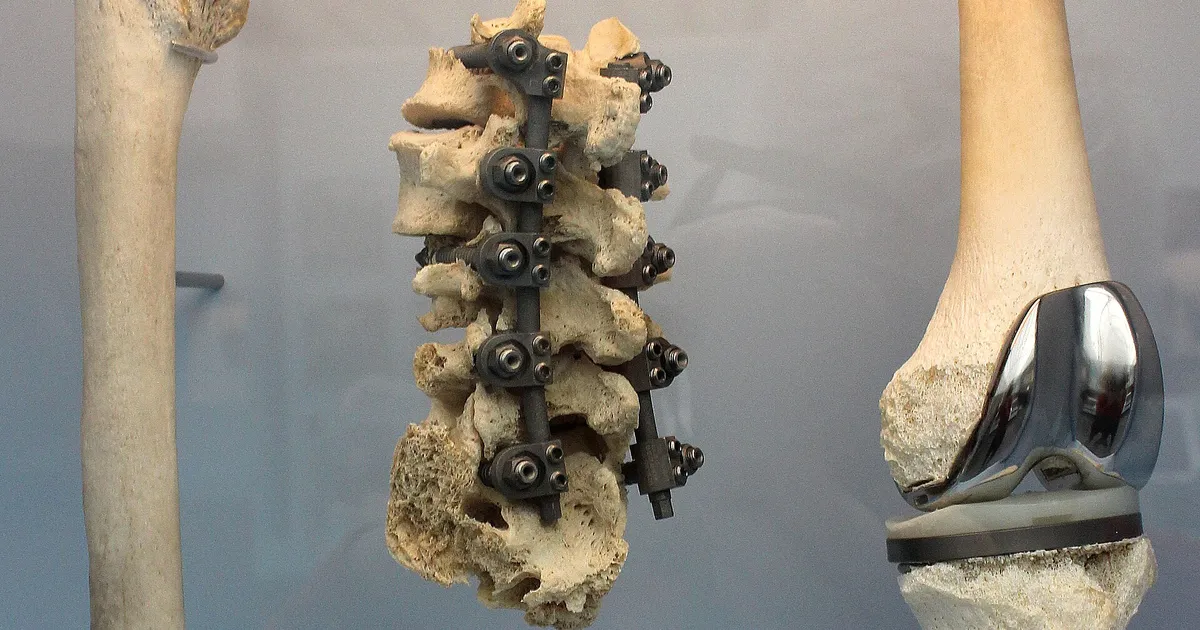
A spinal fusion system is a kit of small metal parts that share a few rules: strong, fatigue resistant and traceable down to the heat of bar. Each part is made differently. A pedicle screw is a Swiss-turned thread. A rod is a ground and cut bar. An interbody cage may be milled from PEEK or titanium or printed and finished. This guide explains how each is made, where cost builds and what a buyer should ask a shop.
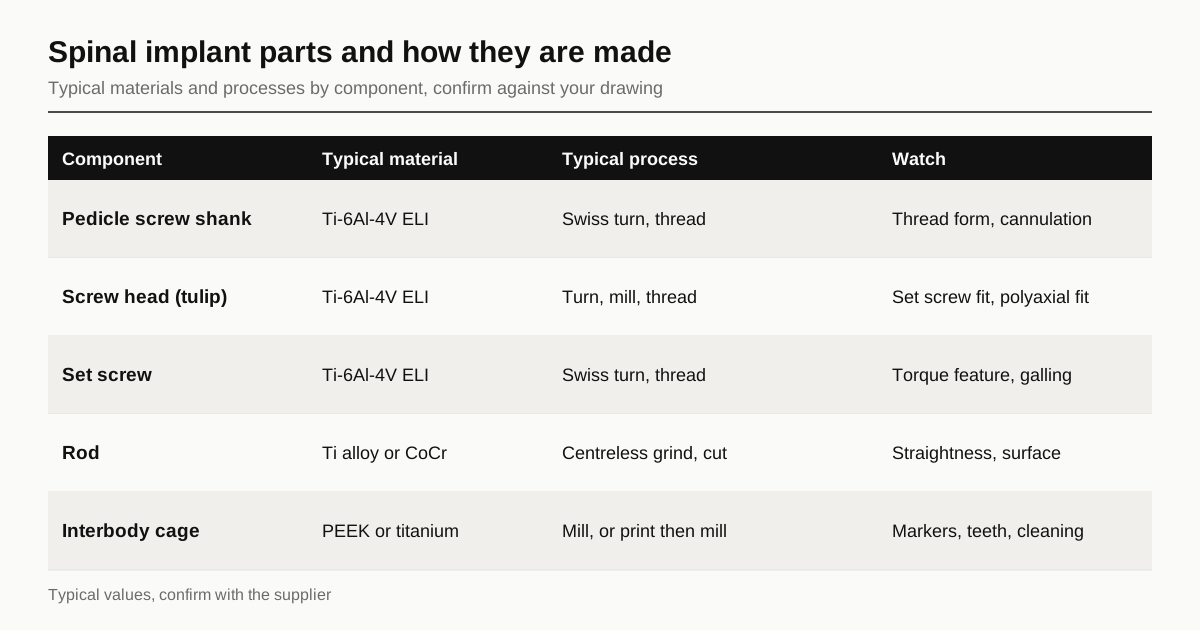
The parts of a posterior fixation system
A common construct fixes screws into the pedicles of adjacent vertebrae and links them with rods. The pieces:
- Pedicle screws. A threaded shank enters the vertebra. In a polyaxial screw the shank ends in a ball that sits in a head, so the head can angle before it is locked.
- Tulip heads. The U-shaped head receives the rod and carries an internal thread for the set screw.
- Set screws. Lock the rod into the head and fix the angle of a polyaxial screw.
- Rods. Round bars linking the screws. A diameter of about 5.5 mm is common, and smaller and larger sizes exist.
- Connectors, hooks and crosslinks. Smaller accessories that link rods or anchor to bone in other ways.
Interbody cages belong to a different family. They sit between vertebrae and carry load while bone grows through them. They come in many shapes for different approaches, and they are made from PEEK, titanium or both.
Materials
| Part | Typical material | Common standard |
|---|---|---|
| Screws, heads, set screws | Ti-6Al-4V ELI | ASTM F136 |
| Rods | Titanium alloy, cobalt chrome or stainless steel | ASTM F136, F1537 or F138 |
| PEEK cages | Implant-grade PEEK | ASTM F2026 |
| Titanium cages | Ti-6Al-4V ELI, solid or porous | ASTM F136 |
| Radiographic markers in PEEK | Tantalum or titanium pins | Per drawing |
Typical choices, the device design sets the actual materials. Our guide to titanium, 316L and PEEK for medical parts covers how those materials compare at the machine.
How pedicle screws are made
A pedicle screw is a long, slender, threaded part, which suits a Swiss-type lathe. The shank, the thread, the tip form and the cannulation, where a screw is hollow for a guide wire, can all be cut in one setup. Our article on bone screw machining at Swiss shops covers that route, and the thread choice between whirling and single-point is covered in thread whirling against single-point threading.
Features that add time:
- Dual-lead or variable-pitch threads. They hold better in bone and take more programming and inspection.
- Self-tapping flutes. A cutting tip needs a milled or ground flute with a sharp edge.
- Cannulation. A long through hole in a slender part needs deep drilling and a straightness check.
- Drive features. A hex or star recess in the head is broached or milled and gauged.
- Ball end on a polyaxial shank. The ball is turned to a sphere and a surface finish that sets the friction in the head.
Tulip heads and set screws
The head is a more complex part than the shank. It is turned and milled, with a U-shaped slot for the rod, an internal thread for the set screw and an internal seat for the shank ball. The internal thread is often a buttress or reverse-angle form that resists splaying of the head arms under load. Inside the head the shank ball has to move freely before locking and hold when locked. Surface finish, roundness and seat angle control that behaviour.
Set screws are small, Swiss-turned parts with a thread and a drive feature. They are torqued in the operating room, so galling between titanium parts is a known risk. Surface treatments, thread class and finish are drawn to reduce it. A set screw that seizes during surgery is a serious field problem, and a shop should know the drawing’s galling controls before it quotes.
Rods
A rod is a bar that has to be straight, round and smooth. Shops make rods from ground bar, cut to length, with chamfered or domed ends and often a marked or knurled section for gripping. Centreless grinding gives roundness and finish. The straightness check and the cut ends both need attention because the rod bends in service and is bent again in the operating room.
Rod material and surface finish affect fatigue performance. Cobalt chrome rods are stiffer than titanium rods and are chosen by some surgeons for deformity correction. Whichever alloy applies, the bar certificate matters, and our guide to medical bar stock certificates shows how to read one.
Interbody cages
Cages differ by material.
- PEEK cages. Milled from PEEK rod, then cleaned. They often carry small tantalum or titanium marker pins, pressed into drilled holes so the cage shows on imaging. Teeth on the faces grip the endplates and are milled or moulded.
- Titanium cages. Milled solid, or printed and then machined and finished. Some designs use a porous structure that is printed.
- Teeth, windows and graft channels. The windows let bone grow through. Burrs inside narrow windows are hard to find and remove.
Cages need careful cleaning because porous and windowed forms trap residue. Our guide to cleaning validation for machined implants explains the approach.
Surface and finish
Spinal parts see several finishes. Titanium screws are often anodized in colours that identify the diameter, so a nurse can pick the right size by eye. Anodizing is a separate process with its own vendor and controls. Rods are polished or blasted according to the design. Cages may carry a texture on the faces. Each finish is another entry on the traceability record.
Testing sits with the device company
Spinal constructs are tested as systems. ASTM F1717 describes static and fatigue tests of spinal implant constructs in a vertebrectomy model. ASTM F2077 covers intervertebral body fusion devices, and ASTM F543 covers bone screws. A machine shop makes parts to the drawing and does not run these tests. The drawing tolerances come from the design verification of the device company, so a change in a thread or a radius is a design change and needs approval.
Why sets drive the cost
A spinal system includes many part numbers. A typical set has screws in several diameters and many lengths, rods in several lengths and heads in several types. Each part number has its own program, inspection plan and lot record. Volume per part number can be small even when total volume is large.
| Cost driver | Why it matters |
|---|---|
| Number of part numbers | Setup and first article repeat for each size |
| Thread complexity | Cycle time and inspection per part |
| Fit between shank and head | Small errors cause loose or tight assemblies |
| Finishing and marking | Anodize, laser mark and clean per lot |
| Traceability | Heat and lot record for every size |
Typical drivers, confirm with the supplier. A buyer who groups part numbers by family and orders by family cuts setup count.
Next step
Before you request quotes, group your part numbers into families and list the critical interfaces: the shank ball and head seat, the thread in the head and the drive recess. Ask each shop how it checks those interfaces and how it keeps lot records across sizes.
We match buyers with machining suppliers and the buyer pays us nothing. We do not machine spinal parts and we do not qualify a supplier for you, because that stays in your own quality system. To send a drawing, request a quote and we reply within 24 business hours.
See also: the spinal implant components reference page for material specifications, test standards and classification across the whole system.
Sources
- ASTM F543, metallic medical bone screws
- ASTM F1717, spinal implant constructs in a vertebrectomy model
- ASTM F2077, intervertebral body fusion devices
Standards and regulations change. Check the current text at the source before you rely on it in a submission.
Frequently asked questions
What are pedicle screws made from?
Most are Ti-6Al-4V ELI to ASTM F136, with stainless steel and cobalt chrome used in some systems. Titanium is common because it is strong for its weight and shows less interference on MRI and CT than steel. The drawing names the material and the standard, and the certificate has to match.
Why are spinal implants sold in sets?
A surgeon needs many sizes in the room because the right one is chosen during the operation. A system therefore has screws in several diameters and lengths, rods in several lengths and a range of cage heights. Each size is its own part number with its own program and records, so volumes per part number are lower than the system total suggests.
Can a shop machine a polyaxial screw head and shank as one part?
A polyaxial screw is an assembly. The shank, the tulip head, an internal ring or seat and the set screw are machined separately and assembled, often by the device maker or an assembly vendor. The ball-and-socket fit between shank and head is the critical interface.
Need a quote for this part?
Send the drawing. We match you with up to 3 medical machining suppliers and reply within 24 business hours.
Get matched with a medical machining supplier