Guides / Technical
Dental Implant Abutment Machining: What Suppliers Quote
October 14, 2026
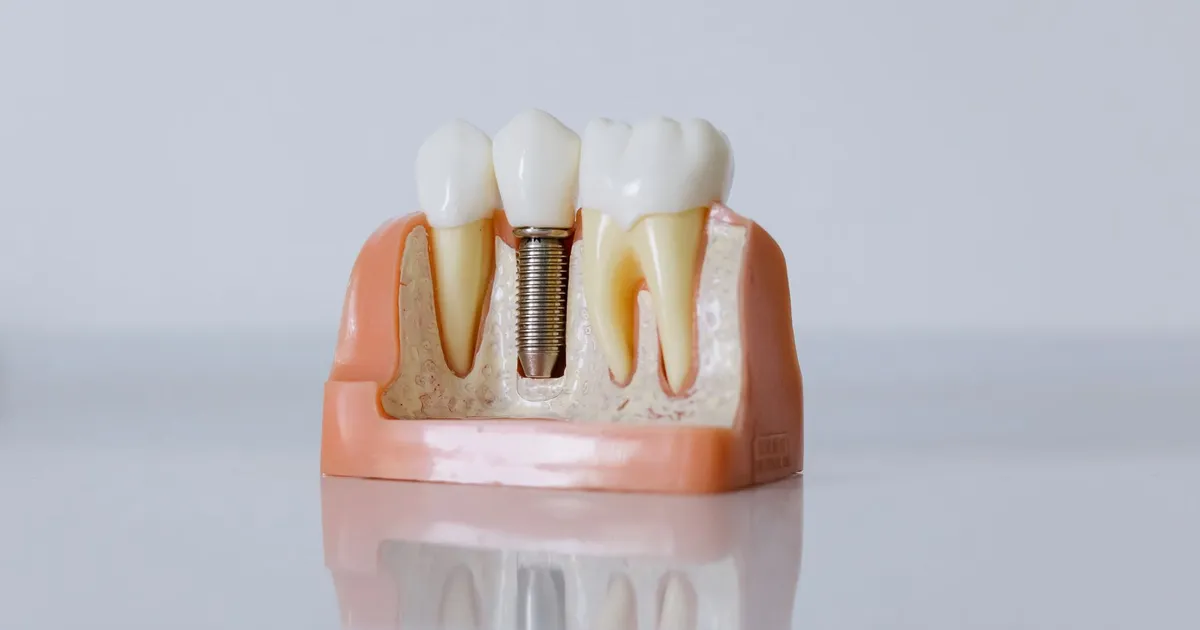
A dental abutment is small, simple to describe and hard to price. Two quotes for the same drawing can differ by a factor of two, and the gap comes from a handful of features. This guide walks through what a supplier adds up when it quotes machined abutments, where the price moves and what a buyer can put on the drawing to get comparable numbers.
What an abutment is
An implant sits in the jawbone. The abutment attaches to the implant and carries the crown or bridge through the gum. A small screw, separate from the abutment, clamps the two together. The abutment has four zones a machinist cares about:
- The connection. The form at the bottom that mates with the implant, often an internal hex, a conical seat or both.
- The collar and emergence profile. The shape that passes through the gum, which may be straight, flared or custom.
- The margin. The upper edge where the crown seats.
- The screw access channel. The through hole for the clamping screw, with a seat for the screw head.
Several types exist. Stock abutments are made in volume from a standard drawing. Custom abutments are milled to a patient-specific design from digital files. Titanium bases carry a ceramic crown bonded to a machined metal base. Multi-unit abutments sit on several implants to carry a bridge. Healing abutments and impression copings are temporary parts with their own volumes and rules.
Where the work is done
Stock abutments are small turned parts with milled flats and a cross-drilled or bored channel. They run on Swiss-type lathes or on mill-turn machines, from titanium bar. Our guide to Swiss turning for medical device components explains why slender round parts suit that machine. Custom abutments are typically milled from a pre-formed blank on a five-axis machine.
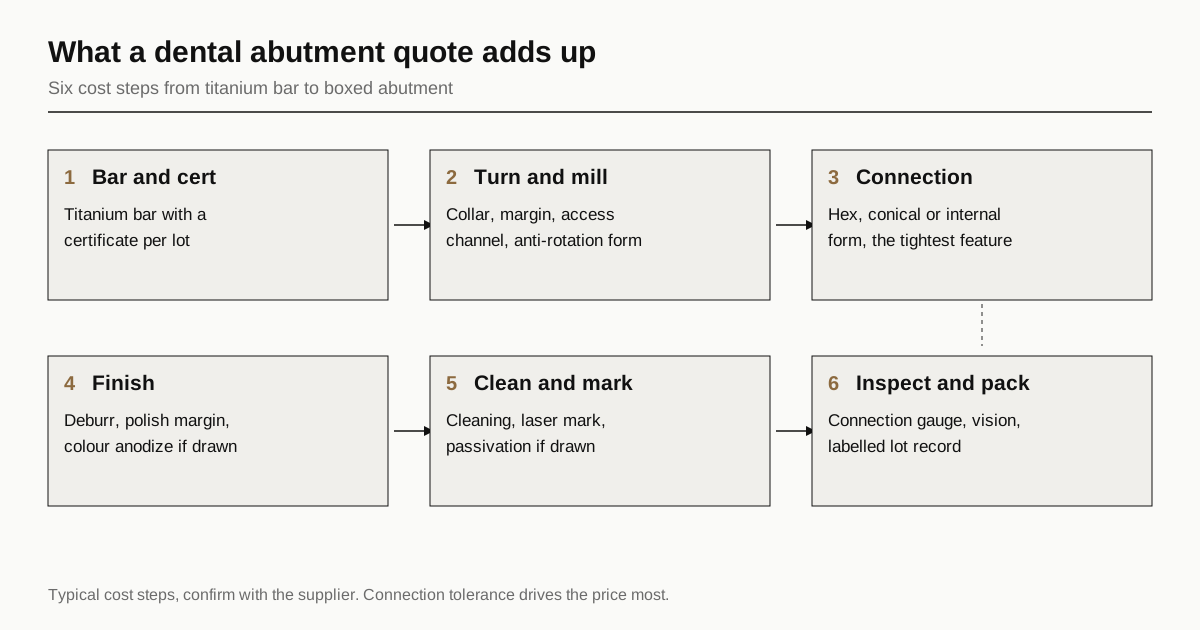
What a supplier adds up
| Cost step | What it covers |
|---|---|
| Bar stock and certificate | Titanium bar with a certificate per lot, plus the scrap allowance for parting off |
| Turning and milling | Collar, margin, screw channel, flats and anti-rotation geometry |
| Connection | Hex or conical form, the tightest tolerance on the part |
| Finishing | Deburring, margin polishing and, if drawn, anodizing for colour |
| Cleaning and marking | Cleaning, laser marking for lot or UDI, passivation if drawn |
| Inspection and packing | Gauge and vision checks, lot record and labelled packaging |
Typical cost steps, confirm with the supplier. The connection and the volume move the price more than anything else.
The connection
The connection decides whether an abutment seats on the implant without rocking. The clearance between the abutment and the implant is small, and the allowed tolerance on the mating form is often a few micrometres to a few tens of micrometres, depending on the design. The drawing gives the number. A shop runs a gauge or a vision system on every part or on a sample, according to the control plan.
Several things drive the cost of this one feature:
- Tolerance. A tighter number means slower finishing passes and more scrap.
- Tool wear. Small form tools wear, and the shop changes them early.
- Machine stability. Temperature drift moves a micrometre-level feature.
- Gauging. A purpose-made gauge costs money and has to be controlled.
- Source of the geometry. The shop needs a drawing it may use. If the buyer supplies the implant maker’s connection data, the right to use it is the buyer’s matter.
A geometry that is wrong by a few micrometres can still look perfect to the eye. The control plan has to define how it is measured. Our guide to tolerances on machined medical parts covers where tolerance cost starts to climb.
Material
Most metal abutments are made from titanium. The two common choices are unalloyed titanium and Ti-6Al-4V ELI. Our guide to Ti-6Al-4V ELI against Grade 4 explains the difference. For abutments the drawing names the grade, and the shop buys bar to match, with a certificate tied to the heat. The reading order for that certificate is in our guide to medical bar stock certificates.
Finishing
Abutments pass through the patient’s gum, so surface finish and cleanliness matter. Finishing steps often include:
- Deburring. Burrs at the connection and the screw seat affect fit, and burrs at the margin can damage the crown.
- Polishing. The collar and margin may be polished to a drawn finish.
- Anodizing. Some abutments are anodized for a gold or pink tone that shows less through thin gum. The colour comes from the oxide layer thickness.
- Coatings. Some designs use a titanium nitride coating. A coating is a separate process with its own vendor and records.
- Passivation and cleaning. The cleaning route follows the drawing and the device company’s validation. Our guide to cleaning validation for machined implants explains how limits get set.
Each step adds a vendor or a cell, a lot record and a place for something to go wrong.
Marking and traceability
Abutments are small, and a laser mark has to fit on a limited area. The mark carries a lot code, a size code or a UDI element, depending on the design. The position must avoid the connection, the seat and the margin. Our guide to UDI laser marking on machined parts explains why marking position and depth are tested rather than assumed.
Volume and the quote
Stock abutments have a different cost structure from custom ones.
| Type | Typical volume | Cost shape |
|---|---|---|
| Stock abutment | Hundreds to thousands per lot | Setup spread over many parts, price falls with volume |
| Multi-unit abutment | Medium lots | Several angled forms, more setup and gauging |
| Custom abutment | One at a time | Milled per design, price set by cycle time and blank |
| Titanium base | Medium to high | Two interface forms, tight fit to the ceramic |
Typical shapes, confirm with the supplier. A buyer who asks for a unit price at three quantities sees the curve.
Process validation
Features that cannot be fully inspected on every part, such as an internal surface or a cleaning outcome, fall under process validation. ISO 13485 clause 7.5.6 requires validation of processes whose output cannot be verified by later inspection. Our guide to IQ, OQ and PQ for machined medical parts explains what the supplier runs. The device company decides what needs validation.
What to put on the drawing
A drawing that gets comparable quotes states:
- The material, the standard and the edition.
- The connection geometry, its tolerance and how it is measured.
- The surface finish on the collar, the margin and the seat.
- The colour or coating, if any, and the process that produces it.
- The marking content, position and method.
- The cleaning, passivation and packaging requirements.
- The quantities for the quote and the expected annual volume.
Packaging and shipping
Abutments are small and easy to damage. A scratch on the margin or a dent on the connection ruins the part, and loose parts in a bag knock each other. Shops pack them in individual cells, in foam or in blister trays, and label each tray with the lot. Some device companies add their own sterile or non-sterile packaging step after receipt. State on the drawing whether parts ship cleaned and bagged or ready for the device maker’s own cleaning, and whether the lot record travels with the shipment or by email.
Next step
Before you request quotes, check which of those seven lines your drawing already answers. Ask each shop to name its inspection method for the connection and to say which finishing steps it does in house.
For how to compare two abutment quotes on the same scope, see the medical machining quote guide.
We match buyers with machining suppliers and the buyer pays us nothing. We do not machine abutments, and we do not advise on regulatory pathways or qualify a supplier for you, because that stays in your own quality system. To send a drawing, request a quote and we reply within 24 business hours.
Sources
- ASTM F136, wrought titanium-6aluminum-4vanadium ELI alloy for surgical implant applications
- ISO 13485:2016, medical devices, quality management systems (clause 7.5.6, validation of processes)
Standards and regulations change. Check the current text at the source before you rely on it in a submission.
Frequently asked questions
What material are dental abutments made from?
Most metal abutments are machined from titanium, either unalloyed titanium or Ti-6Al-4V ELI to ASTM F136. Zirconia abutments exist too and are milled and sintered, which is a different supply chain. The drawing names the material and the standard, and the certificate has to match.
Why is the connection the most expensive feature?
The connection is the interface to the implant, and it has to fit with very little clearance. It is cut in the finishing operation, inspected most closely and scrapped most often when wrong. Time, tooling and gauging for that one feature drive the price more than the visible shape does.
Can a shop machine abutments to fit another maker's implants?
A shop can cut the geometry on a drawing it is given. Whether the device company may make a compatible abutment, and under which regulatory pathway, is a question for its regulatory team. We do not advise on that. Put the source of the connection drawing and the fit requirement in the request.
Need a quote for this part?
Send the drawing. We match you with up to 3 medical machining suppliers and reply within 24 business hours.
Get matched with a medical machining supplier